

Santa Cecilia Glass Frog
Teratohyla midas
Silhouette: Dmitry Bogdanov (vectorized by T. Michael Keesey) · PhyloPic
- KingdomAnimalia (Animals)
- PhylumChordata (Chordates)
- ClassAmphibia (Amphibians)
- OrderAnura (Frogs and Toads)
- FamilyCentrolenidae (Glass Frogs)
- GenusTeratohyla
- SpeciesTeratohyla midas (Santa Cecilia Glass Frog)
About the Santa Cecilia Glass Frog
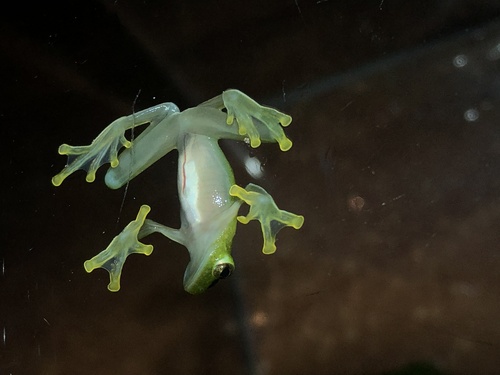
Teratohyla midas (common name: Santa Cecilia Cochran frog) is a species of frog in the family Centrolenidae, which are also known as glass frogs. The species Teratohyla midas was first recorded in 1973 by Lynch, J. D., & Duellman, W. E. This Amazonian species appears to be semi-transparent with gold flecks on its back. Though many species of the glass frog, Centrolendidae, are similar in terms of diet and habitats, they vary greatly among limbs and other physiologies. Because of the similarities between T. midas and other glass frogs, Centrolendidae, researchers often group T. midas together with other species within the same family.
T. midas is arboreal, meaning that they mainly live in trees. Through their semi-opaque skins, one can see the green bones and if the specimen is female, the humerus spine. Their snout has a truncated shape from the dorsal view leading to an angled appearance around the lateral nostril region. Adult snout-vent length is around 17.4 millimetres (0.69 in) to 19.2 mm (0.76 in) in males and 20.6 mm (0.81 in) to 25.6 mm (1.01 in) in females. The shape of the finger discs of T. midas is rounded and truncated, and all discs are around the... Wikipedia →
Recent sightings of Santa Cecilia Glass Frog in Manu National Park
LIVEiNaturalistClosest Relatives at Manu National Park
 White-hearted Glass Frog
Hyalinobatrachium carlesvilai

 Bell Glass Frog
Cochranella nola

 Eastern Cane Toad
Rhinella marina

White-lined Leaf Frog
Phyllomedusa vaillantii

Amazon Sheep Frog
Hamptophryne boliviana

 Surinam Horned Frog
Ceratophrys cornuta

 Rocket Tree Frog
Boana lanciformis

Map Tree Frog
Boana geographica

Red Snouted Tree Frog
Scinax ruber

 Peru white-lipped frog
Leptodactylus rhodonotus

Madre de Dios Thin-toed Frog
Leptodactylus didymus

Rio Mamore Robber Frog
Pristimantis fenestratus
Global Distribution
Warmer areas are where this animal is recorded most often.
Parks Where Found
| # | Park | Country | Daily sighting probability |
|---|---|---|---|
| 1 | Yasuní National Park | 🇪🇨 Ecuador | |
| 2 | Cuyabeno Wildlife Reserve | 🇪🇨 Ecuador | |
| 3 | Manu National Park | 🇵🇪 Peru |