

Dark Fruit-eating Bat
Artibeus obscurus
Silhouette: Jorge D. Carballo-Morales, based on a photo by Mario Barroso · PhyloPic
- KingdomAnimalia (Animals)
- PhylumChordata (Chordates)
- ClassMammalia (Mammals)
- OrderChiroptera (Bats)
- FamilyPhyllostomidae (New World Leaf-nosed Bats)
- GenusArtibeus (Neotropical Fruit Bats)
- SpeciesArtibeus obscurus (Dark Fruit-eating Bat)
About the Dark Fruit-eating Bat
The dark fruit-eating bat (Artibeus obscurus), is a bat species from South America. Dark fruit-eating bats are relatively small, with an average body length of 8 cm (3.1 in), and weighing from 30 to 52 g (1.1 to 1.8 oz). Their fur is longer and darker than that of their closest relatives, being dark brown to sooty black over most of the body, with a white frosting. The underparts are paler, and there are also faint stripes of pale fur on the face. The nose-leaf is broad, with a distinct horseshoe separated from the upper lip. The snout is relatively narrow for a bat of its small size, and the ears are rounded, with a sharply pointed tragus.
Dark-fruit eating bats are found throughout the Amazon Basin. They are known from all but the southernmost parts of Brazil, from the Guyanas, and from the Amazonian regions of countries from Venezuela to Bolivia. They inhabit rainforests from sea level to 1,400 m (4,600 ft), and, in the southern part of their range, savannah and patchy semi-deciduous forests. There are no recognised subspecies.
The bats are generally low-flying, travelling close to the ground through forested terrain... Wikipedia →
Recent sightings of Dark Fruit-eating Bat in Manu National Park
LIVEiNaturalistClosest Relatives at Manu National Park
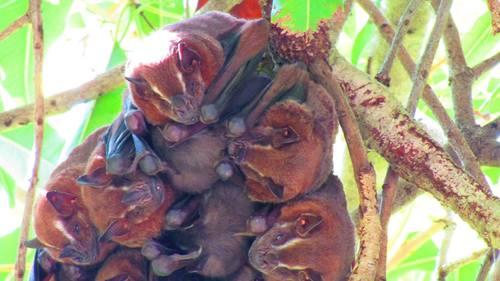
 Great Fruit-eating Bat
Artibeus lituratus

Flat-faced Fruit-eating Bat
Artibeus planirostris

 Greater Spear-nosed Bat
Phyllostomus hastatus

 Big-eared Woolly Bat
Chrotopterus auritus

Vampire Bat
Desmodus rotundus

Hart's Fruit-eating Bat
Enchisthenes hartii

Striped Spearnosed Bat
Gardnerycteris crenulatum

Niceforo's Big-eared Bat
Trinycteris nicefori

Common tent-making Bat
Uroderma bilobatum

Bidentate Yellow-eared Bat
Vampyriscus bidens
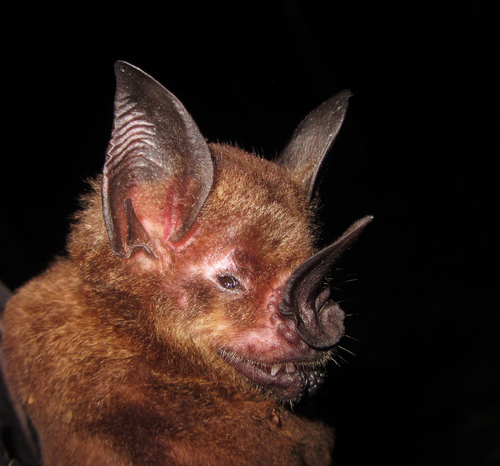
lesser spear-nosed bat
Phyllostomus elongatus

pale-faced bat
Phylloderma stenops
Global Distribution
Warmer areas are where this animal is recorded most often.
Parks Where Found
| # | Park | Country | Daily sighting probability |
|---|---|---|---|
| 1 | Madidi National Park | 🇧🇴 Bolivia | |
| 2 | Tambopata National Reserve | 🇵🇪 Peru | |
| 3 | Yasuní National Park | 🇪🇨 Ecuador | |
| 4 | Manu National Park | 🇵🇪 Peru | |
| 5 | Cuyabeno Wildlife Reserve | 🇪🇨 Ecuador |