

Flat-faced Fruit-eating Bat
Artibeus planirostris
Silhouette: Jorge D. Carballo-Morales, based on a photo by Mario Barroso · PhyloPic
- KingdomAnimalia (Animals)
- PhylumChordata (Chordates)
- ClassMammalia (Mammals)
- OrderChiroptera (Bats)
- FamilyPhyllostomidae (New World Leaf-nosed Bats)
- GenusArtibeus (Neotropical Fruit Bats)
- SpeciesArtibeus planirostris (Flat-faced Fruit-eating Bat)
About the Flat-faced Fruit-eating Bat
The flat-faced fruit-eating bat (Artibeus planirostris) is a South American species of bat in the family Phyllostomidae. It is sometimes considered a subspecies of the Jamaican fruit bat, but can be distinguished by its larger size, the presence of faint stripes on the face, and of a third molar tooth on each side of the upper jaw. Genetic analysis has also shown that the two species may not be closely related.
Flat-faced fruit-eating bats are moderately sized bats, with adults measuring 8 to 11 centimetres (3.1 to 4.3 in) in total length and weighing 40 to 69 grams (1.4 to 2.4 oz). The fur is brownish-grey over most of the body, becoming grey on the underparts, although there are faint whitish stripes on the face. As their name suggests, the bats have a broad skull with a short snout. The ears are triangular, with rounded tips, although short compared with those of many other bats, and with a small tragus. The snout bears a prominent triangular nose-leaf. The wings are dark brown or blackish, with white tips. A well-developed uropatagium stretches between the legs, but there is no visible tail.
Flat-faced fruit-eating bats are found... Wikipedia →
Recent sightings of Flat-faced Fruit-eating Bat in Manu National Park
LIVEiNaturalistClosest Relatives at Manu National Park

 Dark Fruit-eating Bat
Artibeus obscurus
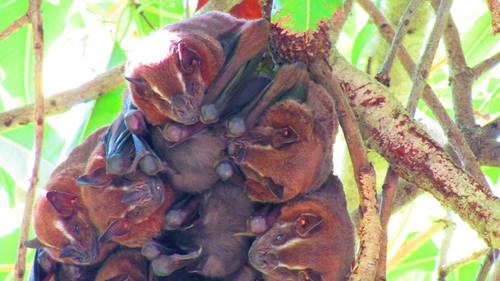
Great Fruit-eating Bat
Artibeus lituratus

 Greater Spear-nosed Bat
Phyllostomus hastatus

 Big-eared Woolly Bat
Chrotopterus auritus

Vampire Bat
Desmodus rotundus

Hart's Fruit-eating Bat
Enchisthenes hartii

Striped Spearnosed Bat
Gardnerycteris crenulatum

Niceforo's Big-eared Bat
Trinycteris nicefori

Common tent-making Bat
Uroderma bilobatum

Bidentate Yellow-eared Bat
Vampyriscus bidens
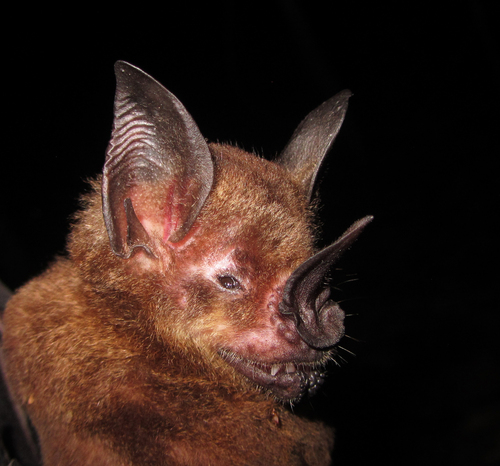
lesser spear-nosed bat
Phyllostomus elongatus

pale-faced bat
Phylloderma stenops
Global Distribution
Warmer areas are where this animal is recorded most often.
Parks Where Found
| # | Park | Country | Daily sighting probability |
|---|---|---|---|
| 1 | Main Ridge Forest Reserve | 🇹🇹 Trinidad and Tobago | |
| 2 | Tambopata National Reserve | 🇵🇪 Peru | |
| 3 | Yasuní National Park | 🇪🇨 Ecuador | |
| 4 | Manu National Park | 🇵🇪 Peru |