

Common Big-eared Bat
Micronycteris microtis
Silhouette: Roberto Díaz Sibaja · PhyloPic
- KingdomAnimalia (Animals)
- PhylumChordata (Chordates)
- ClassMammalia (Mammals)
- OrderChiroptera (Bats)
- FamilyPhyllostomidae (New World Leaf-nosed Bats)
- GenusMicronycteris (Little Big-eared Bats)
- SpeciesMicronycteris microtis (Common Big-eared Bat)
About the Common Big-eared Bat
The common big-eared bat (Micronycteris microtis) is a bat species from South and Central America. It is a member of the family Phyllostomidae. Recent research has demonstrated this bat's ability to find motionless food within clutter. Echolocating bats discriminate between background and prey based on glints or Doppler shifts in the echo induced by the (wing-)movements of the prey, but M. microtis can detect completely motionless prey. The species shares both the leaf-nose formation and the trait of sound emission through the nostrils with all Phyllostomidae, but its behavior is understood to be unique: the bat is able to discriminate ecologically relevant stimuli within an extremely complex cluttered sonic environment.
The echolocation call of M. microtis is a broad band multi-harmonic FM sweep with most energy in the second harmonic between 95 and 75 kHz, i.e. quite similar to that of Macrophyllum macrophyllum, although presumably of lower intensity.
M. microtis mothers will provide pups with prey items for 5 months after weaning. It is a small species of bat with individuals weighing 3.4–9.1 g (0.12–0.32 oz). Its forearm length is 32–38 mm (1.3–1.5 in). Its ears... Wikipedia →
Recent sightings of Common Big-eared Bat in Montes Azules Biosphere Reserve
LIVEiNaturalistClosest Relatives at Montes Azules Biosphere Reserve

 Jamaican Fruit-eating Bat
Artibeus jamaicensis

 Big-eared Woolly Bat
Chrotopterus auritus
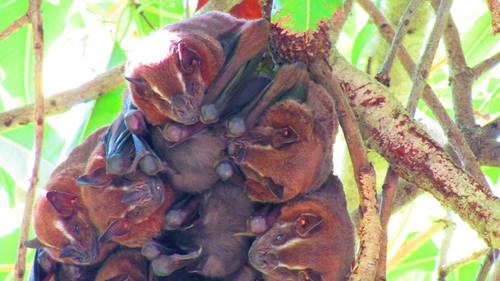
Great Fruit-eating Bat
Artibeus lituratus

 Heller's Broad-nosed Bat
Platyrrhinus helleri

Cozumelan Golden Bat
Mimon cozumelae

Tomes's Sword-nosed Bat
Lonchorhina aurita

Northern Yellow-shouldered Bat
Sturnira parvidens

 fringe-lipped bat
Trachops cirrhosus

Northern Little Yellow-eared Bat
Vampyressa thyone

Pygmy Fruit Eating Bat
Artibeus phaeotis
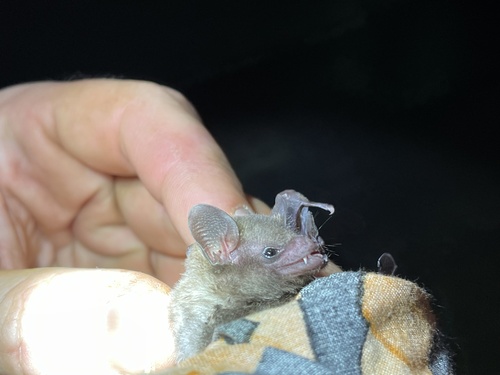
Godman's long-tailed bat
Choeroniscus godmani

Great Stripe-faced Bat
Vampyrodes major
Global Distribution
Warmer areas are where this animal is recorded most often.
Parks Where Found
| # | Park | Country | Daily sighting probability |
|---|---|---|---|
| 1 | Tikal National Park | 🇬🇹 Guatemala | |
| 2 | Montes Azules Biosphere Reserve | 🇲🇽 Mexico | |
| 3 | Soberanía National Park | 🇵🇦 Panama | |
| 4 | Ría Lagartos Biosphere Reserve | 🇲🇽 Mexico | |
| 5 | Arrecifes de Cozumel National Park | 🇲🇽 Mexico | |
| 6 | Calakmul Biosphere Reserve | 🇲🇽 Mexico | |
| 7 | Arenal Volcano National Park | 🇨🇷 Costa Rica |