

Middle American Burrowing Snake
Adelphicos quadrivirgatum
Silhouette: Alex Slavenko · PhyloPic
- KingdomAnimalia (Animals)
- PhylumChordata (Chordates)
- ClassSquamata
- FamilyColubridae (Colubrid Snakes)
- GenusAdelphicos (American Burrowing Snakes)
- SpeciesAdelphicos quadrivirgatum (Middle American Burrowing Snake)
About the Middle American Burrowing Snake
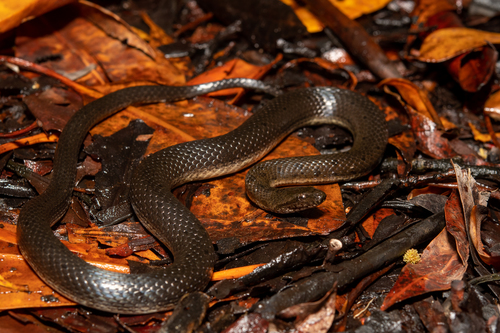
Adelphicos quadrivirgatum, also known commonly as the Middle American burrowing snake and la zacatera de Jan in New World Spanish, is a species of snake in the subfamily Dipsadinae of the family Colubridae. The species is native to Mexico and Central America.
Adelphicos quadrivirgatum is found in Belize, Guatemala, Honduras, Nicaragua, and Mexico; in Mexico, its range extends southward from the Mexican states of Nuevo León and Tamaulipas to San Luis Potosí, Veracruz, Querétaro, Hidalgo, Puebla, Oaxaca, and Chiapas.
Adelphicos quadrivirgatum inhabits tropical and subtropical wet and moist forest at elevations from sea level to 1,740 m (5,710 ft). Adelphicos quadrivirgatus is terrestrial, and it is often found beneath logs. Adelphicos quadrivirgatum is a small snake. Adult females may attain a total length of 36.5 cm (14.4 in), which includes a tail 5.5 cm (2.2 in) long. Dorsally, it is pale reddish brown, with four or five blackish narrow stripes. Ventrally, it is whitish with a brown stripe along the middle of the tail.
Adelphicos quadrivirgatum preys mainly on earthworms. Adelphicos... Wikipedia →
Recent sightings of Middle American Burrowing Snake in Montes Azules Biosphere Reserve
LIVEiNaturalistClosest Relatives at Montes Azules Biosphere Reserve

 Red Coffee Snake
Ninia sebae

 Blunthead Tree Snake
Imantodes cenchoa

 Northern Cat-eyed Snake
Leptodeira septentrionalis

Speckled Racer
Drymobius margaritiferus

Mexican Parrot Snake
Leptophis mexicanus

Puffing Snake
Phrynonax poecilonotus

Chicken Snake
Spilotes pullatus
Orangebelly Swamp Snake
Tretanorhinus nigroluteus

Black-striped Snake
Coniophanes imperialis

 Central American Milksnake
Lampropeltis abnorma

False Fer-de-lance
Xenodon rabdocephalus

Dryad Snake
Mastigodryas melanolomus
Global Distribution
Warmer areas are where this animal is recorded most often.
Parks Where Found
| # | Park | Country | Daily sighting probability |
|---|---|---|---|
| 1 | Celaque National Park | 🇭🇳 Honduras | |
| 2 | Cusuco National Park | 🇭🇳 Honduras | |
| 3 | Cockscomb Basin Wildlife Sanctuary | 🇧🇿 Belize | |
| 4 | Lago de Yojoa | 🇭🇳 Honduras | |
| 5 | Montes Azules Biosphere Reserve | 🇲🇽 Mexico |