
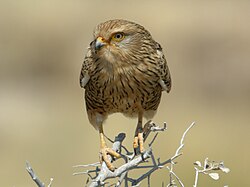



Greater Kestrel
Falco rupicoloides
Silhouette: Shyamal · PhyloPic
- KingdomAnimalia (Animals)
- PhylumChordata (Chordates)
- ClassAves (Birds)
- OrderFalconiformes (Falcons and Caracaras)
- FamilyFalconidae (Falcons and Caracaras)
- GenusFalco (Typical Falcons)
- SpeciesFalco rupicoloides (Greater Kestrel)
About the Greater Kestrel
The greater kestrel (Falco rupicoloides) or white-eyed kestrel is a bird of prey belonging to the falcon family Falconidae. It is one of the largest kestrels and is found in open country in southern and eastern Africa. The plumage of the adult is mainly pale rufous, both above and below. The back, upperwing and flanks are barred with black. The breast has dark streaks and the head is streaked but has no malar stripe unlike the common and lesser kestrels. The rump and tail are grey with black bars; the tail has a white tip. In flight, the whitish underwing contrasts with the darker body. The iris of the eye is whitish, distinguishing the bird from any similar species. The bill is mainly blue-grey and the feet and cere are yellow. Juvenile birds have rufous instead of grey on the tail, streaked flanks and a dark eye.
The bird is 29–37 cm (11–15 in) long with a wingspan of 68–84 cm (27–33 in) The southern subspecies F. r. rupicoloides weighs about 181–334gr (.400–.736 lb). The form F. r. arthuri is smaller, weighing about 165–252gr (.364–.556 lb). The northern subspecies F. r. fieldi is also small and is paler than the others.
The species is usually silent but has a... Wikipedia →
Recent sightings of Greater Kestrel in Moremi Game Reserve
LIVEiNaturalistClosest Relatives at Moremi Game Reserve

 Dickinson's Kestrel
Falco dickinsoni

Red-necked Falcon
Falco chicquera

 Lesser Kestrel
Falco naumanni

Amur Falcon
Falco amurensis

Lanner Falcon
Falco biarmicus

 Eurasian Hobby
Falco subbuteo

Rock Kestrel
Falco rupicolus

 Peregrine Falcon
Falco peregrinus

Red-footed Falcon
Falco vespertinus
Global Distribution
Warmer areas are where this animal is recorded most often.
Parks Where Found
| # | Park | Country | Daily sighting probability |
|---|---|---|---|
| 1 | Etosha National Park | 🇳🇦 Namibia | |
| 2 | Kgalagadi Transfrontier Park | 🇿🇦 South Africa | |
| 3 | Namib-Naukluft National Park | 🇳🇦 Namibia | |
| 4 | Ngorongoro Conservation Area | 🇹🇿 Tanzania | |
| 5 | Serengeti National Park | 🇹🇿 Tanzania | |
| 6 | Amboseli National Park | 🇰🇪 Kenya | |
| 7 | Kidepo Valley National Park | 🇺🇬 Uganda | |
| 8 | Chobe National Park | 🇧🇼 Botswana | |
| 9 | Hwange National Park | 🇿🇼 Zimbabwe | |
| 10 | Lake Nakuru National Park | 🇰🇪 Kenya | |
| 11 | Tarangire National Park | 🇹🇿 Tanzania | |
| 12 | Moremi Game Reserve | 🇧🇼 Botswana | |
| 13 | Kruger National Park | 🇿🇦 South Africa | |
| 14 | Garden Route National Park | 🇿🇦 South Africa | |
| 15 | Waterberg Plateau Park | 🇳🇦 Namibia | |
| 16 | Meru National Park | 🇰🇪 Kenya | |
| 17 | Pilanesberg National Park | 🇿🇦 South Africa | |
| 18 | Addo Elephant National Park | 🇿🇦 South Africa | |
| 19 | Arusha National Park | 🇹🇿 Tanzania |
Quick answers
What are the chances of seeing a Greater Kestrel in Moremi Game Reserve?
Under 5% of wildlife watchers report a Greater Kestrel sighting in Moremi Game Reserve, based on 5 verified sightings from GBIF citizen-science data.
When is the best time to see Greater Kestrel in Moremi Game Reserve?
March has the highest sighting rate for Greater Kestrel in Moremi Game Reserve in our monthly data.