


White-browed Wagtail
Motacilla maderaspatensis
Silhouette: Martin Bulla, based on Ren Hathway's illustration · PhyloPic
- KingdomAnimalia (Animals)
- PhylumChordata (Chordates)
- ClassAves (Birds)
- OrderPasseriformes (Perching Birds)
- FamilyMotacillidae (Wagtails and Pipits)
- GenusMotacilla (Wagtails)
- SpeciesMotacilla maderaspatensis (White-browed Wagtail)
About the White-browed Wagtail
The white-browed wagtail or large pied wagtail (Motacilla maderaspatensis) is a medium-sized bird and is the largest member of the wagtail family. They are conspicuously patterned with black above and white below, a prominent white brow, shoulder stripe and outer tail feathers. White-browed wagtails are native to the Indian subcontinent, common near small water bodies and have adapted to urban environments where they often nest on roof tops. The specific name is derived from the Indian city of Madras (now Chennai).
The white-browed wagtail was formally described in 1789 by the German naturalist Johann Friedrich Gmelin in his revised and expanded edition of Carl Linnaeus's Systema Naturae. He placed it with the wagtails in the genus Motacilla and coined the binomial name Motacilla maderaspatensis. The specific epithet is Modern Latin for the locality, Madras (or Madraspattanam and now Chennai) in southern India. Gmelin's account was based on the "black and white wagtail" that had been described and illustrated in 1713 by the English naturalist John Ray. The species is monotypic: no subspecies are recognised.
The white-browed wagtail is the largest species... Wikipedia →
Recent sightings of White-browed Wagtail in Mudumalai National Park
LIVEiNaturalistClosest Relatives at Mudumalai National Park

 Grey Wagtail
Motacilla cinerea

Citrine Wagtail
Motacilla citreola

Western Yellow Wagtail
Motacilla flava
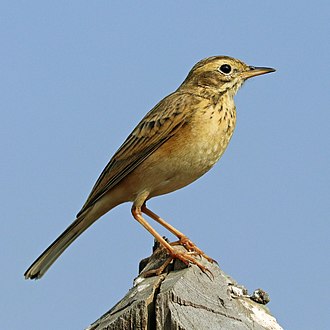
 Oriental Pipit
Anthus rufulus

 Forest Wagtail
Dendronanthus indicus

 Tree Pipit
Anthus trivialis

 Blyth's Pipit
Anthus godlewskii

 Oriental Magpie-Robin
Copsychus saularis

 Brahminy Starling
Sturnia pagodarum

 Red-whiskered Bulbul
Pycnonotus jocosus

 Long-tailed Shrike
Lanius schach

 Jungle Myna
Acridotheres fuscus
Global Distribution
Warmer areas are where this animal is recorded most often.
Parks Where Found
| # | Park | Country | Daily sighting probability |
|---|---|---|---|
| 1 | Chitwan National Park | 🇳🇵 Nepal | |
| 2 | Bandipur National Park | 🇮🇳 India | |
| 3 | Mudumalai National Park | 🇮🇳 India | |
| 4 | Nagarhole National Park | 🇮🇳 India | |
| 5 | Royal Bardia National Park | 🇳🇵 Nepal | |
| 6 | Jim Corbett National Park | 🇮🇳 India | |
| 7 | Satpura National Park | 🇮🇳 India | |
| 8 | Periyar National Park | 🇮🇳 India | |
| 9 | Ranthambore National Park | 🇮🇳 India | |
| 10 | Eravikulam National Park | 🇮🇳 India | |
| 11 | Keoladeo National Park | 🇮🇳 India | |
| 12 | Gir National Park | 🇮🇳 India | |
| 13 | Kanha National Park | 🇮🇳 India | |
| 14 | Bandhavgarh National Park | 🇮🇳 India | |
| 15 | Royal Manas National Park | 🇧🇹 Bhutan | |
| 16 | Manas National Park | 🇮🇳 India | |
| 17 | Kaziranga National Park | 🇮🇳 India | |
| 18 | Khangchendzonga National Park | 🇮🇳 India | |
| 19 | Langtang National Park | 🇳🇵 Nepal |
Quick answers
What are the chances of seeing a White-browed Wagtail in Mudumalai National Park?
About 40% of wildlife watchers report a White-browed Wagtail sighting in Mudumalai National Park, based on 365 verified sightings from GBIF citizen-science data.
When is the best time to see White-browed Wagtail in Mudumalai National Park?
January has the highest sighting rate for White-browed Wagtail in Mudumalai National Park in our monthly data.