


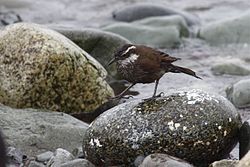


Dark-bellied Cinclodes
Cinclodes patagonicus
Silhouette: Edwin Price · PhyloPic
- KingdomAnimalia (Animals)
- PhylumChordata (Chordates)
- ClassAves (Birds)
- OrderPasseriformes (Perching Birds)
- FamilyFurnariidae (Ovenbirds and Woodcreepers)
- GenusCinclodes
- SpeciesCinclodes patagonicus (Dark-bellied Cinclodes)
About the Dark-bellied Cinclodes
The dark-bellied cinclodes (Cinclodes patagonicus) is a species of bird in the Furnariinae subfamily of the ovenbird family Furnariidae. It is found in Argentina and Chile. The dark-bellied cinclodes was formally described in 1789 by the German naturalist Johann Friedrich Gmelin in his revised and expanded edition of Carl Linnaeus's Systema Naturae. He placed it with the wagtails in the genus Motacilla and coined the binomial name Motacilla patagonica. Gmelin based his description on the "Patagonian warbler" that had been described in 1783 by the English ornithologist John Latham in his book A General Synopsis of Birds. Latham had examined specimens in the Leverian Museum in London. The dark-bellied cinclodes is now one of 15 species placed in the genus Cinclodes that was introduced in 1840 by George Robert Gray.
Genetic data show that the dark-bellied cinclodes, Peruvian seaside cinclodes (C. taczanowskii), and the Chilean seaside cinclodes (C. nigrofumosus) are sister species. Two subspecies of the dark-bellied cinclodes are recognised, the nominate C. p. patagonicus (Gmelin, JF, 1789) and C. p. chilensis (Lesson, RP, 1828).
The dark... Wikipedia →
Recent sightings of Dark-bellied Cinclodes in Nahuel Huapi National Park
LIVEiNaturalistClosest Relatives at Nahuel Huapi National Park

 Buff-winged Cinclodes
Cinclodes fuscus

 Gray-flanked Cinclodes
Cinclodes oustaleti

 Thorn-tailed Rayadito
Aphrastura spinicauda

 White-throated Treerunner
Pygarrhichas albogularis

 Plain-mantled Tit-Spinetail
Leptasthenura aegithaloides

Sharp-billed Canastero
Asthenes pyrrholeuca

 Des Murs's Wiretail
Sylviorthorhynchus desmursii

Rufous-banded Miner
Geositta rufipennis

 Rufous Hornero
Furnarius rufus

Scale-throated Earthcreeper
Upucerthia dumetaria

Patagonian Forest Earthcreeper
Upucerthia saturatior

Austral Canastero
Asthenes anthoides
Global Distribution
Warmer areas are where this animal is recorded most often.
Parks Where Found
| # | Park | Country | Daily sighting probability |
|---|---|---|---|
| 1 | Vicente Pérez Rosales National Park | 🇨🇱 Chile | |
| 2 | Nahuel Huapi National Park | 🇦🇷 Argentina | |
| 3 | Torres del Paine National Park | 🇨🇱 Chile | |
| 4 | Tierra del Fuego National Park | 🇦🇷 Argentina |
Quick answers
What are the chances of seeing a Dark-bellied Cinclodes in Nahuel Huapi National Park?
About 50% of wildlife watchers report a Dark-bellied Cinclodes sighting in Nahuel Huapi National Park, based on 902 verified sightings from GBIF citizen-science data.
When is the best time to see Dark-bellied Cinclodes in Nahuel Huapi National Park?
March has the highest sighting rate for Dark-bellied Cinclodes in Nahuel Huapi National Park in our monthly data.