

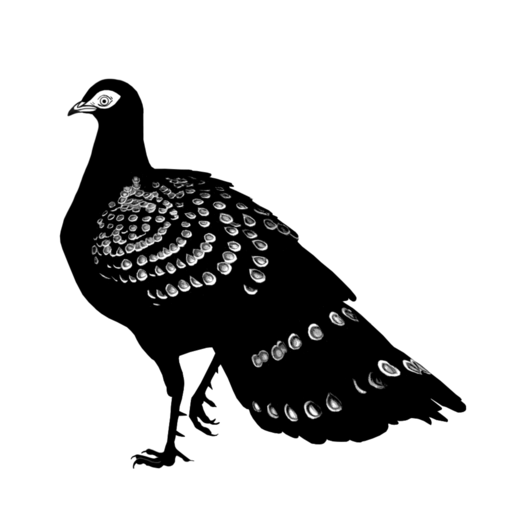
Grey Peacock-Pheasant
Polyplectron bicalcaratum
Silhouette: Yuxin Li · PhyloPic
- KingdomAnimalia (Animals)
- PhylumChordata (Chordates)
- ClassAves (Birds)
- OrderGalliformes (Landfowl)
- FamilyPhasianidae (Pheasants, Grouse, and Allies)
- GenusPolyplectron (Peacock-Pheasants)
- SpeciesPolyplectron bicalcaratum (Grey Peacock-Pheasant)
About the Grey Peacock-Pheasant
The grey peacock-pheasant (Polyplectron bicalcaratum), also known as Burmese peacock-pheasant, is a large Asian member of the order Galliformes. In 1747 the English naturalist George Edwards included an illustration and a description of the grey peacock-pheasant in the second volume of his A Natural History of Uncommon Birds. He used the English name "The Peacock Pheasant from China". Edwards based his hand-coloured etching on a live bird which was given to Robert Walpole, 1st Earl of Orford. When in 1758 the Swedish naturalist Carl Linnaeus updated his Systema Naturae for the tenth edition, he placed the grey peacock-pheasant with the Indian peafowl in the genus Pavo. Linnaeus included a brief description, coined the binomial name Pavo bicalcaratum and cited Edwards' work. The grey peacock-pheasant is now placed in the genus Polyplectron that was introduced in 1807 by the Dutch zoologist Coenraad Jacob Temminck. The genus name Polyplectron combines the Ancient Greek polus meaning "many" with plēktron meaning "cock's spur". The specific epithet bicalcaratum combines the Latin bi meaning "two" with calcar, calcaris meaning "spur".
Although several subspecies have been... Wikipedia →
Recent sightings of Grey Peacock-Pheasant in Namdapha National Park
LIVEiNaturalist


Global Distribution
Warmer areas are where this animal is recorded most often.
Parks Where Found
| # | Park | Country | Daily sighting probability |
|---|---|---|---|
| 1 | Namdapha National Park | 🇮🇳 India | |
| 2 | Kaeng Krachan National Park | 🇹🇭 Thailand | |
| 3 | Royal Manas National Park | 🇧🇹 Bhutan | |
| 4 | Kaziranga National Park | 🇮🇳 India |
Quick answers
What are the chances of seeing a Grey Peacock-Pheasant in Namdapha National Park?
About 30% of wildlife watchers report a Grey Peacock-Pheasant sighting in Namdapha National Park, based on 364 verified sightings from GBIF citizen-science data.
When is the best time to see Grey Peacock-Pheasant in Namdapha National Park?
March has the highest sighting rate for Grey Peacock-Pheasant in Namdapha National Park in our monthly data.