



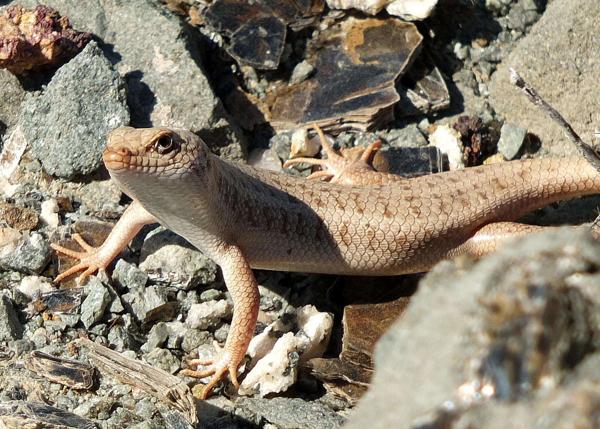
Kalahari Tree Skink
Trachylepis spilogaster
Silhouette: David Orr · PhyloPic
- KingdomAnimalia (Animals)
- PhylumChordata (Chordates)
- ClassSquamata
- FamilyScincidae (Skinks)
- GenusTrachylepis (Afro-Malagasy Mabuyas)
- SpeciesTrachylepis spilogaster (Kalahari Tree Skink)
About the Kalahari Tree Skink
The Kalahari tree skink (Trachylepis spilogaster), or spiny mabuya, is a species of lizard in the skink family (Scincidae). The species is endemic to southern Africa, including Namibia, South Africa, western Botswana, and southern Angola.
Kalahari tree skinks have been found to live around trees that contain the large colonial nests of the sociable weaver. Their numbers are higher in these areas despite a known predator of skinks, the pygmy falcon, also nesting in these trees. It is theorized that the increased opportunity for places of refuge outweigh the risk of predation. Skinks found on colony trees have learned to eavesdrop on sociable weavers to warn of approaching pygmy falcons. Wikipedia →
Recent sightings of Kalahari Tree Skink in Namib-Naukluft National Park
LIVEiNaturalistClosest Relatives at Namib-Naukluft National Park

 Variegated Skink
Trachylepis variegata

Western Rock Skink
Trachylepis sulcata

Sharp-lipped Mabuya
Trachylepis acutilabris

Western three-striped skink
Trachylepis occidentalis
Hoesch's Mabuya
Trachylepis hoeschi

Karasburg Tree Skink
Trachylepis sparsa

Wahlberg’s Striped Skink
Trachylepis wahlbergii

Short Blind Dart Skink
Typhlacontias brevipes

Meyer's Legless Skink
Typhlosaurus meyeri

Western Dwarf Burrowing Skink
Scelotes capensis
Haacke's Legless Skink
Typhlosaurus braini
Global Distribution
Warmer areas are where this animal is recorded most often.
Parks Where Found
| # | Park | Country | Daily sighting probability |
|---|---|---|---|
| 1 | Waterberg Plateau Park | 🇳🇦 Namibia | |
| 2 | Etosha National Park | 🇳🇦 Namibia | |
| 3 | Namib-Naukluft National Park | 🇳🇦 Namibia | |
| 4 | Kgalagadi Transfrontier Park | 🇿🇦 South Africa | |
| 5 | Moremi Game Reserve | 🇧🇼 Botswana |
Quick answers
What are the chances of seeing a Kalahari Tree Skink in Namib-Naukluft National Park?
About 30% of wildlife watchers report a Kalahari Tree Skink sighting in Namib-Naukluft National Park, based on 92 verified sightings from GBIF citizen-science data.
When is the best time to see Kalahari Tree Skink in Namib-Naukluft National Park?
April has the highest sighting rate for Kalahari Tree Skink in Namib-Naukluft National Park in our monthly data.