
Meyer's Legless Skink
Typhlosaurus meyeri
- KingdomAnimalia (Animals)
- PhylumChordata (Chordates)
- ClassSquamata
- FamilyScincidae (Skinks)
- GenusTyphlosaurus
- SpeciesTyphlosaurus meyeri (Meyer's Legless Skink)
About the Meyer's Legless Skink
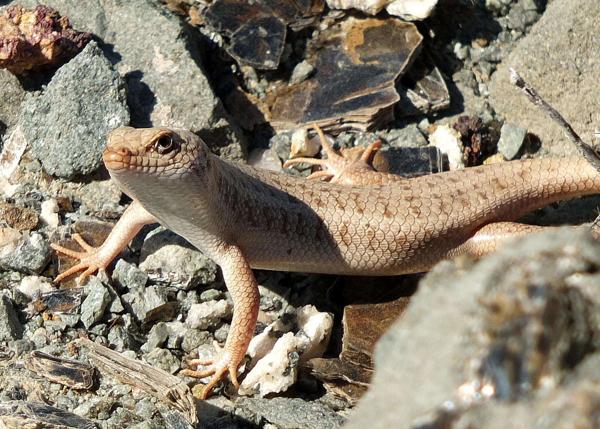
Meyer's blind legless skink (Typhlosaurus meyeri), also commonly known as Meyer's legless skink, and the variable blind legless skink, is a species of lizard in the subfamily Acontinae of the family Scincidae. The species is native to southern Africa.
The specific name meyeri, is in honor of German ornithologist Adolf Bernhard Meyer. Adults of Typhlosaurus meyeri usually have a snout-to-vent length (SVL) of 12–16 cm (4.7–6.3 in). The maximum recorded SVL is 18.8 cm (7.4 in).
Typhlosaurus meyeri is found in extreme southwestern Namibia and adjacent extreme northwestern South Africa. The preferred natural habitat of Typhlosaurus meyeri is sandy desert, at elevations of 50–400 m (160–1,310 ft).
Typhlosaurus meyeri is ovoviviparous. Bauer, A.M.; Branch, W.R. (2003). "The herpetofauna of the Richtersveld National Park, Northern Cape Province, Republic of South Africa". Herpetological Natural History. 8: 111–160. Boettger, O. (1894). "Eine neue Eidechse aus Südwest-Afrika". Abhandlungen und Berichte des Königlichen und Anthropologisch-Etnographischen Museums... Wikipedia →
Closest Relatives at Namib-Naukluft National Park
Haacke's Legless Skink
Typhlosaurus braini

Kalahari Tree Skink
Trachylepis spilogaster

Variegated Skink
Trachylepis variegata

Short Blind Dart Skink
Typhlacontias brevipes

Western Rock Skink
Trachylepis sulcata

Sharp-lipped Mabuya
Trachylepis acutilabris

Western three-striped skink
Trachylepis occidentalis
Hoesch's Mabuya
Trachylepis hoeschi

Karasburg Tree Skink
Trachylepis sparsa

Wahlberg’s Striped Skink
Trachylepis wahlbergii

Western Dwarf Burrowing Skink
Scelotes capensis
Global Distribution
Where this species is recorded worldwide. Restricted to human observations from 2019 onwards — the same kind of record and the same period the probabilities on this page are built from, so collar-tracking studies, camera-trap arrays and museum specimens are excluded. Around Santa Rosa that removes 5,924 GPS fixes from a handful of tagged jaguars.
where this species is recorded (GBIF density — it tracks where observers go, not how likely a sighting is) · parks where it occurs — tap a pin for the sighting probability there
Parks Where Found
| # | Park | Country | Daily sighting probability |
|---|---|---|---|
| 1 | Namib-Naukluft National Park | 🇳🇦 Namibia |
More parks will be added in future updates.