

Western Sand Snake
Psammophis trigrammus
Silhouette: SeismicShrimp · PhyloPic
- KingdomAnimalia (Animals)
- PhylumChordata (Chordates)
- ClassSquamata
- FamilyPsammophiidae (Sand Snakes)
- GenusPsammophis (Sand Racers)
- SpeciesPsammophis trigrammus (Western Sand Snake)
About the Western Sand Snake
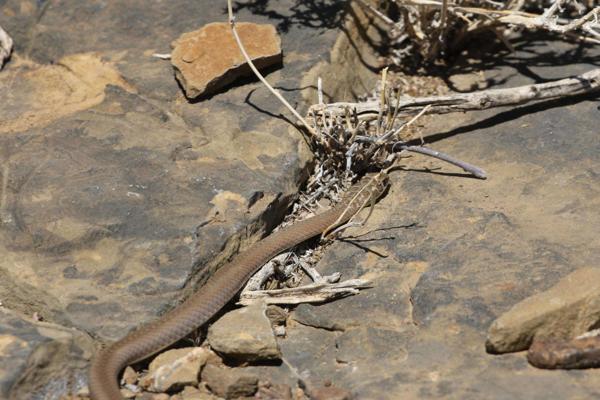
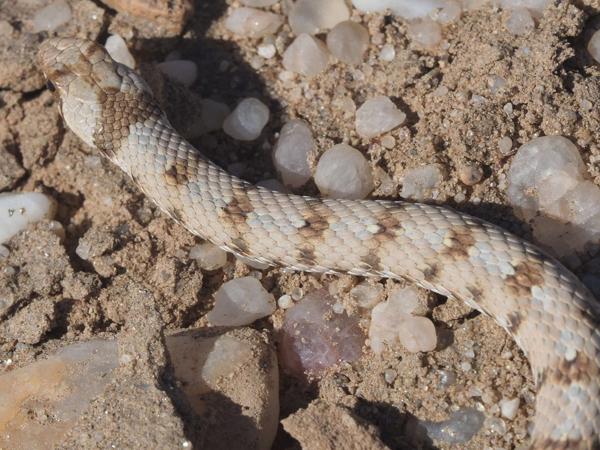
Psammophis trigrammus, the western sand snake, is a diurnal, terrestrial snake in the family Psammophiidae from southwestern Africa. Species of Psammophis are notorious for being slender and quick. Females are typically smaller and peak at a snout-vent length (SVL) of 540 mm, whereas males can reach a snout-vent length of up to 750 mm. It weighs 55 - 140 g (2 to 5 ounces), with males being smaller and lighter than females.
P. trigrammus has distinct coloration varying from pale olive to grey- brown along with a reddish to yellowish posterior. It is the Psammophis in southern Africa to have 9 supralabials and it has the highest ventral scale count of any southern African Psammophis.
In the genus Psammophis, the maxillary dentition consists of 10-13 teeth. One to two enlarged fang-like teeth are present near the middle of the maxilla, typically having an interspace, along with the posterior teeth being grooved. Within the mandible, the anterior teeth are elongated, while the posterior ones are smaller.
The head is demarcated from the neck and distinctly elongate, with a well-defined canthus rostralis. The eyes are relatively large with round pupils, the body is slender... Wikipedia →
Recent sightings of Western Sand Snake in Namib-Naukluft National Park
LIVEiNaturalistClosest Relatives at Namib-Naukluft National Park


Global Distribution
Warmer areas are where this animal is recorded most often.
Parks Where Found
| # | Park | Country | Daily sighting probability |
|---|---|---|---|
| 1 | Namib-Naukluft National Park | 🇳🇦 Namibia |
More parks will be added in future updates.