
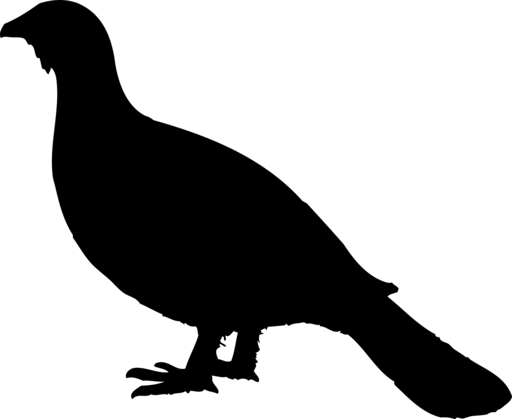
Western Capercaillie
Tetrao urogallus
Silhouette: Elisabeth Östman · PhyloPic
- KingdomAnimalia (Animals)
- PhylumChordata (Chordates)
- ClassAves (Birds)
- OrderGalliformes (Landfowl)
- FamilyPhasianidae (Pheasants, Grouse, and Allies)
- GenusTetrao (Capercaillies)
- SpeciesTetrao urogallus (Western Capercaillie)
About the Western Capercaillie
The western capercaillie (Tetrao urogallus), also known as the Eurasian capercaillie, wood grouse, heather cock, cock-of-the-woods, or simply capercaillie, is a heavy member of the grouse tribe and the largest of all extant grouse species. Found across Europe and the Palearctic, this primarily-ground-dwelling forest grouse is renowned for its courtship display. The bird shows extreme sexual dimorphism, with males nearly twice the size of females. The global population is listed as "least concern" under the IUCN, although the populations of central Europe are declining and fragmented, or possibly extirpated.
The western capercaillie is one of two living species under the genus Tetrao, which also includes the lesser-known black-billed capercaillie. The western capercaillie was formally described in 1758 by the Swedish naturalist Carl Linnaeus in the tenth edition of his Systema Naturae under its current binomial name Tetrao urogallus. Linnaeus specified the type locality as Europe but this is now restricted to Sweden. The genus name is a Latin word that was used for both the black grouse and the western capercaillie. The specific epithet urogallus is a Neo-Latin partial... Wikipedia →
Recent sightings of Western Capercaillie in Pyrénées National Park
LIVEiNaturalistClosest Relatives at Pyrénées National Park

 Red-legged Partridge
Alectoris rufa

 Common Quail
Coturnix coturnix

 Red Junglefowl
Gallus gallus

 Common Peafowl
Pavo cristatus

Reeves's Pheasant
Syrmaticus reevesii

 Gray Partridge
Perdix perdix

 Ring-necked Pheasant
Phasianus colchicus

 Rock Ptarmigan
Lagopus muta

 Helmeted Guineafowl
Numida meleagris
Global Distribution
Warmer areas are where this animal is recorded most often.
Parks Where Found
| # | Park | Country | Daily sighting probability |
|---|---|---|---|
| 1 | Bavarian Forest National Park | 🇩🇪 Germany | |
| 2 | Cairngorms National Park | 🇬🇧 United Kingdom | |
| 3 | Pyrénées National Park | 🇫🇷 France | |
| 4 | Triglav National Park | 🇸🇮 Slovenia | |
| 5 | Aigüestortes National Park | 🇪🇸 Spain | |
| 6 | Hohe Tauern National Park | 🇦🇹 Austria | |
| 7 | Tatra National Park | 🇸🇰 Slovakia |
Quick answers
What are the chances of seeing a Western Capercaillie in Pyrénées National Park?
Under 5% of wildlife watchers report a Western Capercaillie sighting in Pyrénées National Park, based on 23 verified sightings from GBIF citizen-science data.
When is the best time to see Western Capercaillie in Pyrénées National Park?
May has the highest sighting rate for Western Capercaillie in Pyrénées National Park in our monthly data.