


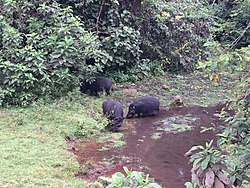


Giant Forest Hog
Hylochoerus meinertzhageni
Silhouette: T. Michael Keesey (after Masteraah) · PhyloPic
- KingdomAnimalia (Animals)
- PhylumChordata (Chordates)
- ClassMammalia (Mammals)
- OrderArtiodactyla (Even-toed Ungulates and Cetaceans)
- FamilySuidae (Suids)
- GenusHylochoerus (Forest Hogs)
- SpeciesHylochoerus meinertzhageni (Giant Forest Hog)
About the Giant Forest Hog
The giant forest hog (Hylochoerus meinertzhageni), the only member of its genus (Hylochoerus), is native to wooded habitats in Africa and is one of the largest wild members of the pig family, Suidae, along with a few subspecies of the wild boar. It was first described in 1904. The specific name honours Richard Meinertzhagen, who shot the type specimen in Kenya and had it shipped to the Natural History Museum in England.
The giant forest hog is, on average, the largest living species of suid. Adults can measure from 1.3 to 2.1 m (4 ft 3 in to 6 ft 11 in) in head-and-body length, with an additional tail length of 25 to 45 cm (9.8 to 17.7 in). Adults stand 0.75 to 1.1 m (2 ft 6 in to 3 ft 7 in) in height at the shoulder, and can weigh from 100 to 275 kg (220 to 606 lb). Females are smaller than males. Females weigh a median of approximately 167 kg (368 lb), as opposed to males, which weigh a median of 210 kg (460 lb). The eastern nominate subspecies is slightly larger than H. m. rimator of Central Africa and noticeably larger than H. m. ivoriensis of West Africa, with the latter sometimes being scarcely larger than related species such as the bushpig with a top recorded... Wikipedia →
Recent sightings of Giant Forest Hog in Queen Elizabeth National Park
LIVEiNaturalistClosest Relatives at Queen Elizabeth National Park

 Common Warthog
Phacochoerus africanus

 Common Hippopotamus
Hippopotamus amphibius

 Kob
Kob
Kobus kob

 Waterbuck
Kobus ellipsiprymnus

 African Buffalo
Syncerus caffer

 Topi
Topi
Damaliscus korrigum

 Northern Bushbuck
Tragelaphus scriptus

 Northern Giraffe
Giraffa camelopardalis

Tsessebe
Damaliscus lunatus

Impala
Aepyceros melampus

 Common Eland
Taurotragus oryx
Global Distribution
Warmer areas are where this animal is recorded most often.
Parks Where Found
| # | Park | Country | Daily sighting probability |
|---|---|---|---|
| 1 | Aberdare National Park | 🇰🇪 Kenya | |
| 2 | Queen Elizabeth National Park | 🇺🇬 Uganda | |
| 3 | Virunga National Park | 🇨🇩 Democratic Republic of the Congo |
Quick answers
What are the chances of seeing a Giant Forest Hog in Queen Elizabeth National Park?
About 50% of wildlife watchers report a Giant Forest Hog sighting in Queen Elizabeth National Park, based on 66 verified sightings from GBIF citizen-science data.
When is the best time to see Giant Forest Hog in Queen Elizabeth National Park?
January has the highest sighting rate for Giant Forest Hog in Queen Elizabeth National Park in our monthly data.