
Tahiti Petrel
Pseudobulweria rostrata
- KingdomAnimalia (Animals)
- PhylumChordata (Chordates)
- ClassAves (Birds)
- OrderProcellariiformes (Tubenoses)
- FamilyProcellariidae (Shearwaters and Petrels)
- GenusPseudobulweria (Tropical Petrels)
- SpeciesPseudobulweria rostrata (Tahiti Petrel)
About the Tahiti Petrel
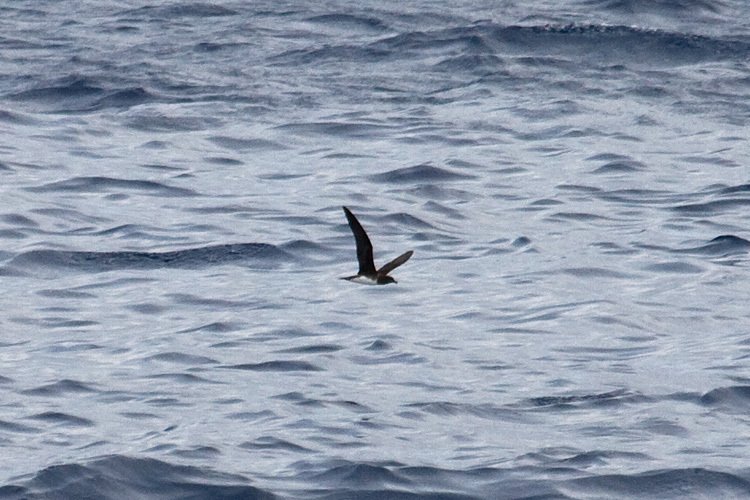
The Tahiti petrel (Pseudobulweria rostrata) is a medium-sized, dark brown and white seabird found across the Pacific Ocean. The species comprises two subspecies: P. r. rostrata which breeds in the west-central Pacific Ocean, and P. r. trouessarti which breeds in the tropical and subtropical Pacific Ocean. The Tahiti petrel belongs to the Procellariidae family and is the most studied member of the Pseudobulweria genus which comprises three critically endangered species. Similarly, the Tahiti petrel is considered near threatened by the 2018 IUCN Red List of Threatened Species. Threats include introduced rats, feral cats, pigs, dogs, nickel mining, and light pollution.
In 1848, Peale collected and described the first specimen of this species in Tahiti. Then, in 1917, the Tahiti petrel was separated into two subspecies: rostrata and trouessarti, due to trouessarti's more robust bill. Not only is there a physiological difference between the two, they are also found in different geographic locations. P. r. rostrata, the nominate subspecies, breeds in the west-central Pacific Ocean whereas P. r. trouessarti breeds in the tropical and subtropical Pacific Ocean. Also, after originally... Wikipedia →
Closest Relatives at Raja Ampat
Beck's Petrel
Pseudobulweria becki

Streaked Shearwater
Calonectris leucomelas

Bulwer's Petrel
Bulweria bulwerii

Wedge-tailed Shearwater
Puffinus pacificus

Matsudaira's Storm Petrel
Oceanodroma matsudairae

Wilson's Storm Petrel
Oceanites oceanicus

Swinhoe' Storm-petrel
Oceanodroma monorhis
Global Distribution
Where this species is recorded worldwide. Restricted to human observations from 2019 onwards — the same kind of record and the same period the probabilities on this page are built from, so collar-tracking studies, camera-trap arrays and museum specimens are excluded. Around Santa Rosa that removes 5,924 GPS fixes from a handful of tagged jaguars.
where this species is recorded (GBIF density — it tracks where observers go, not how likely a sighting is) · parks where it occurs — tap a pin for the sighting probability there
Parks Where Found
| # | Park | Country | Daily sighting probability |
|---|---|---|---|
| 1 | Cabo Blanco Absolute Nature Reserve | 🇨🇷 Costa Rica | |
| 2 | Manuel Antonio National Park | 🇨🇷 Costa Rica | |
| 3 | Raja Ampat | 🇮🇩 Indonesia | |
| 4 | Corcovado National Park | 🇨🇷 Costa Rica |