
Mayan Antthrush
Formicarius moniliger
Silhouette: Abraão B. Leite · PhyloPic
- KingdomAnimalia (Animals)
- PhylumChordata (Chordates)
- ClassAves (Birds)
- OrderPasseriformes (Perching Birds)
- FamilyFormicariidae (Antthrushes)
- GenusFormicarius (Formicarius Antthrushes)
- SpeciesFormicarius moniliger (Mayan Antthrush)
About the Mayan Antthrush
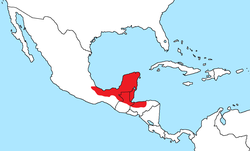
The Mayan antthrush (Formicarius moniliger) is a species of bird in the family Formicariidae. It is found in Belize, Guatemala, Honduras, and Mexico. The Mayan antthrush was formally described as a species by the English ornithologist Philip Slater in 1857. It was later treated by many ornithologists as a subspecies of the black-faced antthrush (Formicarius analis), though some retained it as a species due to significant differences in the two taxa's vocalizations. By 2021 major taxonomic systems had adopted the split.
The Mayan antthrush has three subspecies, the nominate F. m. moniliger (Sclater, PL, 1857), F. m. pallidus (Lawrence, 1882), and F. m. intermedius (Ridgway, 1908). The Mayan antthrush is 15 to 19 cm (5.9 to 7.5 in) long and weighs about 56 to 64 g (2.0 to 2.3 oz). The sexes have the same plumage. Adults of the nominate subspecies have a dusky brown crown. They have a small white spot on their lores and bare bluish skin around their eye. Their face from their bill to their eye is black that extends down to include the chin and throat. The sides of their neck are rufous that continues across under the black throat. Their... Wikipedia →
Recent sightings of Mayan Antthrush in Ría Lagartos Biosphere Reserve
LIVEiNaturalistClosest Relatives at Ría Lagartos Biosphere Reserve

 Yellow Warbler
Setophaga petechia

 Great-tailed Grackle
Quiscalus mexicanus

 Tropical Mockingbird
Mimus gilvus

 Tropical Kingbird
Tyrannus melancholicus

 Mangrove Vireo
Vireo pallens

 Great Kiskadee
Pitangus sulphuratus

 Northern Waterthrush
Parkesia noveboracensis

 Mangrove Swallow
Tachycineta albilinea

 Blue-gray Gnatcatcher
Polioptila caerulea

 Yucatán Wren
Campylorhynchus yucatanicus

 Common Yellowthroat
Geothlypis trichas

 Hooded Oriole
Icterus cucullatus
Global Distribution
Warmer areas are where this animal is recorded most often.
Parks Where Found
| # | Park | Country | Daily sighting probability |
|---|---|---|---|
| 1 | Cockscomb Basin Wildlife Sanctuary | 🇧🇿 Belize | |
| 2 | Montes Azules Biosphere Reserve | 🇲🇽 Mexico | |
| 3 | Tikal National Park | 🇬🇹 Guatemala | |
| 4 | Biotopo Cerro Cahuí | 🇬🇹 Guatemala | |
| 5 | Cerro Azul Meámbar National Park | 🇭🇳 Honduras | |
| 6 | Calakmul Biosphere Reserve | 🇲🇽 Mexico | |
| 7 | Sian Ka'an Biosphere Reserve | 🇲🇽 Mexico | |
| 8 | Pico Bonito National Park | 🇭🇳 Honduras | |
| 9 | Cusuco National Park | 🇭🇳 Honduras | |
| 10 | Ría Lagartos Biosphere Reserve | 🇲🇽 Mexico |