
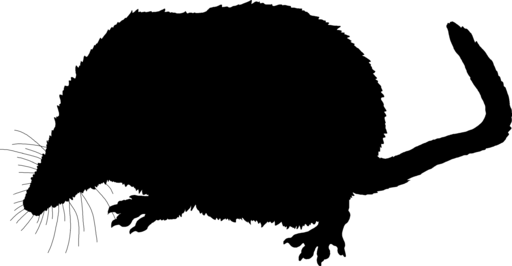
bee shrew
Cryptotis parva
Silhouette: Becky Barnes · PhyloPic
- KingdomAnimalia (Animals)
- PhylumChordata (Chordates)
- ClassMammalia (Mammals)
- OrderSoricomorpha
- FamilySoricidae (Shrews)
- GenusCryptotis (Small-eared Shrews)
- SpeciesCryptotis parva (bee shrew)
About the bee shrew
The North American least shrew (Cryptotis parva) is one of the smallest mammals, growing to be only up to 3 inches long. It has a long pointed snout and a tail never more than twice the length of its hind foot. The dense fur coat is either grayish-brown or reddish-brown with a white belly. Its fur becomes lighter in the summer and darker in the winter. Although similar in appearance to several species of rodents, all shrews are members of the order Eulipotyphla and should not be mistaken for a member of the order Rodentia. The North American least shrew's eyes are small and its ears are completely concealed within its short fur, giving it very poor eyesight and hearing.
It is found from the grasslands of southern Canada through the eastern and central United States and Mexico. In Canada, only a small population of this animal has been found at Long Point in Ontario. The North American least shrew mostly dwells in mesic grasslands, marshes, and meadows. Most shrews prefer these wet habitats, but the least shrew will also inhabit dry upland regions. This species can be found in meadows, fields, and weedy areas, where the vegetation attracts its insect diet. Wikipedia →
Recent sightings of bee shrew in Rocky Mountain National Park
LIVEiNaturalistGlobal Distribution
Warmer areas are where this animal is recorded most often.
Parks Where Found
| # | Park | Country | Daily sighting probability |
|---|---|---|---|
| 1 | Shenandoah National Park | 🇺🇸 United States | |
| 2 | Everglades National Park | 🇺🇸 United States | |
| 3 | Reserva de la Biosfera Mariposa Monarca | 🇲🇽 Mexico | |
| 4 | Chirripó National Park | 🇨🇷 Costa Rica | |
| 5 | Los Quetzales National Park | 🇨🇷 Costa Rica |