



Black-bellied Swamp Snake
Hemiaspis signata
Silhouette: SeismicShrimp · PhyloPic
- KingdomAnimalia (Animals)
- PhylumChordata (Chordates)
- ClassSquamata
- FamilyElapidae (Elapid Snakes)
- GenusHemiaspis (Grey and Marsh Snakes)
- SpeciesHemiaspis signata (Black-bellied Swamp Snake)
About the Black-bellied Swamp Snake
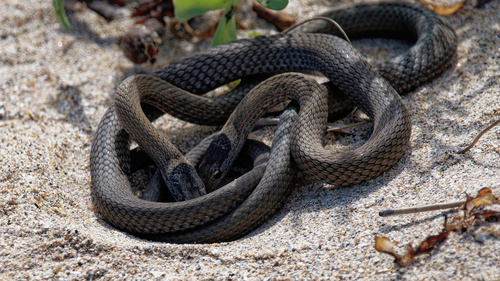
Hemiaspis signata (common names: black-bellied swamp snake and marsh snake) is a species of venomous elapid snake endemic to Australia, where it is found along the east coast. Recognisable by two distinctive narrow white lines on the face, the colour can range from pale olive to black top with a dark grey to black belly. Adults can grow to 70 cm in length, but most specimens are smaller than this. Their diet consists mainly of skinks and frogs.
It was first described in 1859 by Giorgio Jan as Alecto signata. Boulenger GA. 1896. Catalogue of the Snakes in the British Museum (Natural History). Volume III., Containing the Colubridæ (Opisthoglyphæ and Proteroglyphæ)... London: Trustees of the British Museum (Natural History). (Taylor and Francis, printers). xiv + 727 pp. + Plates I-XXV. (Denisonia signata, pp. 338–339).
Jan G, Sordelli F. 1873. Iconographie générale des Ophidiens, Quarante-troisième livraison. Paris: Baillière. Index + Plates I-VI. (Alecto signata, Plate VI, figure 5). (in French). Wikipedia →
Recent sightings of Black-bellied Swamp Snake in Royal National Park
LIVEiNaturalistClosest Relatives at Royal National Park

 Red-bellied Black Snake
Pseudechis porphyriacus

Yellow-faced Whipsnake
Demansia psammophis

Golden Crowned Snake
Cacophis squamulosus

Eastern Brown Snake
Pseudonaja textilis

Small-eyed Snake
Cryptophis nigrescens

 Eastern Tiger Snake
Notechis scutatus

Broad-headed Snake
Hoplocephalus bungaroides

Common Death Adder
Acanthophis antarcticus

Red-naped Snake
Furina diadema
Mustard-bellied Snake
Drysdalia rhodogaster
Global Distribution
Warmer areas are where this animal is recorded most often.
Parks Where Found
| # | Park | Country | Daily sighting probability |
|---|---|---|---|
| 1 | Lamington National Park | 🇦🇺 Australia | |
| 2 | Springbrook National Park | 🇦🇺 Australia | |
| 3 | Royal National Park | 🇦🇺 Australia | |
| 4 | Booderee National Park | 🇦🇺 Australia | |
| 5 | Daintree National Park | 🇦🇺 Australia | |
| 6 | Blue Mountains National Park | 🇦🇺 Australia |
Quick answers
What are the chances of seeing a Black-bellied Swamp Snake in Royal National Park?
About 10% of wildlife watchers report a Black-bellied Swamp Snake sighting in Royal National Park, based on 7 verified sightings from GBIF citizen-science data.
When is the best time to see Black-bellied Swamp Snake in Royal National Park?
May has the highest sighting rate for Black-bellied Swamp Snake in Royal National Park in our monthly data.