

Red-naped Snake
Furina diadema
Silhouette: SeismicShrimp · PhyloPic
- KingdomAnimalia (Animals)
- PhylumChordata (Chordates)
- ClassSquamata
- FamilyElapidae (Elapid Snakes)
- GenusFurina (Bright-naped Snakes)
- SpeciesFurina diadema (Red-naped Snake)
About the Red-naped Snake
The red-naped snake (Furina diadema) is a small venomous reptile from the family Elapidae. The snakes are found in four Australian states and are listed as 'threatened' in Victoria'. They are nocturnal and feed on small skinks. The young eastern brown snake is similar in appearance.
The red-naped snake has small black eyes, a shiny black head, and neck. Its head appears to be partially flattened. On the upper lip is a streak of white. On the back of the neck there is a well defined patch of orange or red in the shape of a diamond, crescent or oval. The belly can be either a cream colour or white. The remainder of the body is a red-brown colour. The edges of these dorsal scales are either black or dark brown and this makes the scales look like a net.
Furina diadema have a slim body and are considered a small snake. They have been reported to reach a maximum length of 45 cm. Other sources have reported them as reaching a maximum total length of 40 cm. The males are the smaller sex.
Theses snakes have between 160 and 210 ventral scales, a divided anal scale, between 35 and 70 subcaudal scales and generally 15 rows of mid-body scales. Although red-naped snakes... Wikipedia →
Recent sightings of Red-naped Snake in Royal National Park
LIVEiNaturalistClosest Relatives at Royal National Park

 Red-bellied Black Snake
Pseudechis porphyriacus

Yellow-faced Whipsnake
Demansia psammophis

Golden Crowned Snake
Cacophis squamulosus

Eastern Brown Snake
Pseudonaja textilis

Black-bellied Swamp Snake
Hemiaspis signata

Small-eyed Snake
Cryptophis nigrescens

 Eastern Tiger Snake
Notechis scutatus

Broad-headed Snake
Hoplocephalus bungaroides

Common Death Adder
Acanthophis antarcticus
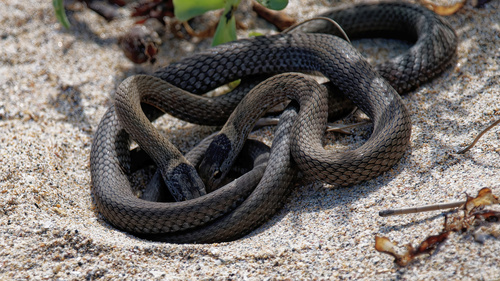
Mustard-bellied Snake
Drysdalia rhodogaster
Global Distribution
Warmer areas are where this animal is recorded most often.
Parks Where Found
| # | Park | Country | Daily sighting probability |
|---|---|---|---|
| 1 | Flinders Ranges National Park | 🇦🇺 Australia | |
| 2 | Lamington National Park | 🇦🇺 Australia | |
| 3 | Blue Mountains National Park | 🇦🇺 Australia | |
| 4 | Royal National Park | 🇦🇺 Australia |