

Koala
Phascolarctos cinereus
Silhouette: Sarah Werning · PhyloPic
- KingdomAnimalia (Animals)
- PhylumChordata (Chordates)
- ClassMammalia (Mammals)
- OrderDiprotodontia (Kangaroos, Possums, Wombats, and Allies)
- FamilyPhascolarctidae (Koalas)
- GenusPhascolarctos (Koalas)
- SpeciesPhascolarctos cinereus (Koala)
About the Koala
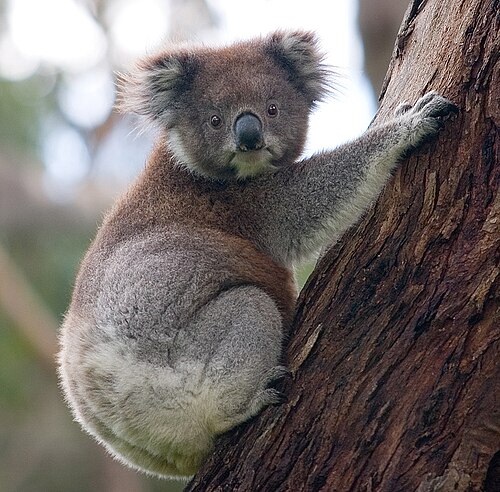
The koala (Phascolarctos cinereus), sometimes inaccurately called the koala bear, is an arboreal herbivorous marsupial native to Australia. It is the only extant representative of the family Phascolarctidae. Its closest living relatives are the wombats. The koala is found in coastal areas of the continent's eastern and southern regions, inhabiting Queensland, New South Wales, Victoria, and South Australia. It is easily recognisable by its stout, tailless body and large head with round, fluffy ears and large, dark nose. The koala has a body length of 60–85 cm (24–33 in) and weighs 4–15 kg (8.8–33.1 lb). Its fur colour ranges from silver grey to chocolate brown. Koalas from the northern populations are typically smaller and lighter in colour than their counterparts further south. These populations are possibly separate subspecies, but not all researchers accept this.
Koalas typically inhabit open Eucalyptus woodland, as the leaves of these trees make up most of their diet. This eucalypt diet has low nutritional and caloric content and contains toxic compounds that deter most other mammals from feeding on them. Koalas are largely sedentary and sleep up to twenty hours a day. They are asocial; only mothers bond to dependent offspring. Adult males communicate with bellows that intimidate rivals and attract mates. Males mark their presence with secretions from scent glands located on their chests. Like other marsupials, koalas give birth to young known as joeys at a very early stage of development. They crawl into their mothers' pouches, where they live for their first six to seven months. They are fully weaned around a year old.
Koalas have few natural predators and parasites, but are threatened by pathogens such as Chlamydiaceae bacteria and koala retrovirus. Koalas are listed as a vulnerable species by the International Union for Conservation of Nature. Among the many threats to their existence are habitat destruction caused by agriculture, urbanisation, droughts, and associated wildfires, some related to climate change. In February 2022, the koala was officially listed as endangered in the Australian Capital Territory, New South Wales, and Queensland. They are however over-abundant in parts of South Australia and Victoria, with population growth at unsustainable levels.
Because of their distinctive appearance, koalas, along with kangaroos, are recognised worldwide as symbols of Australia. They were hunted by Aboriginal Australians and depicted in myths and cave art for millennia. Wikipedia →
Recent sightings of Koala in Royal National Park
LIVEiNaturalistClosest Relatives at Royal National Park

 Swamp Wallaby
Wallabia bicolor

 Common Ringtail Possum
Pseudocheirus peregrinus

 Common Brushtail
Trichosurus vulpecula

 Sugar Glider
Petaurus breviceps

 Eastern Grey Kangaroo
Macropus giganteus

 Eastern Pygmy Possum
Cercartetus nanus

 Feather-tailed Glider
Acrobates pygmaeus

 Greater Glider
Petauroides volans
Global Distribution
Warmer areas are where this animal is recorded most often.
Parks Where Found
| # | Park | Country | Daily sighting probability |
|---|---|---|---|
| 1 | Flinders Chase | 🇦🇺 Australia | |
| 2 | Great Otway National Park | 🇦🇺 Australia | |
| 3 | Lamington National Park | 🇦🇺 Australia | |
| 4 | Springbrook National Park | 🇦🇺 Australia | |
| 5 | Wilsons Promontory National Park | 🇦🇺 Australia | |
| 6 | Blue Mountains National Park | 🇦🇺 Australia | |
| 7 | Royal National Park | 🇦🇺 Australia | |
| 8 | Noosa National Park | 🇦🇺 Australia | |
| 9 | Kosciuszko National Park | 🇦🇺 Australia | |
| 10 | Grampians National Park | 🇦🇺 Australia |
Quick answers
What are the chances of seeing a Koala in Royal National Park?
About 10% of wildlife watchers report a Koala sighting in Royal National Park, based on 16 verified sightings from GBIF citizen-science data.
When is the best time to see Koala in Royal National Park?
October has the highest sighting rate for Koala in Royal National Park in our monthly data.