


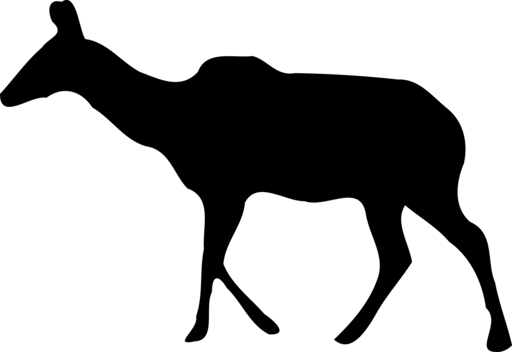
Greater Kudu
Tragelaphus strepsiceros
Silhouette: Robert Hering · PhyloPic
- KingdomAnimalia (Animals)
- PhylumChordata (Chordates)
- ClassMammalia (Mammals)
- OrderArtiodactyla (Even-toed Ungulates and Cetaceans)
- FamilyBovidae (Bovids)
- GenusTragelaphus (Spiral-horned Antelopes)
- SpeciesTragelaphus strepsiceros (Greater Kudu)
About the Greater Kudu
The greater kudu (Tragelaphus strepsiceros) is a large woodland antelope, found throughout eastern and southern Africa. Despite occupying such widespread territory, they are sparsely populated in most areas due to declining habitat, deforestation, and poaching. The greater kudu is one of two species commonly known as kudu, the other being the lesser kudu, T. imberbis.
Kudu ( koo-DOO), or koodoo, is the Khoikhoi name for this antelope. Trag- (Greek) denotes a goat and elaphos (Greek) a deer. Strepho (Greek) means 'twist', and strepsis is 'twisting'. Keras (Greek) refers to the horn of the animal.
Greater kudus have a narrow body with long legs, and their coats can range from brown/bluish grey to reddish brown. They possess between 4 and 12 vertical white stripes along their torso. The head tends to be darker in colour than the rest of the body, and exhibits a small white chevron which runs between the eyes.
Greater kudu bulls tend to be much larger than the cows, and vocalize much more, utilizing low grunts, clucks, humming, and gasping. The bulls also have beards running along their throats, and large horns with two and a half twists,... Wikipedia →
Recent sightings of Greater Kudu in Ruaha National Park
LIVEiNaturalistClosest Relatives at Ruaha National Park

 Northern Bushbuck
Tragelaphus scriptus

 Lesser Kudu
Tragelaphus imberbis

 Impala
Aepyceros melampus

 African Buffalo
Syncerus caffer

 Waterbuck
Kobus ellipsiprymnus

Klipspringer
Oreotragus oreotragus

 Grant's Gazelle
Nanger granti

 Common Eland
Taurotragus oryx

Oribi
Ourebia ourebi

 East African Giraffe
Giraffa tippelskirchi

 Common Hippopotamus
Hippopotamus amphibius

 Common Warthog
Phacochoerus africanus
Global Distribution
Warmer areas are where this animal is recorded most often.
Parks Where Found
Quick answers
What are the chances of seeing a Greater Kudu in Ruaha National Park?
About 50% of wildlife watchers report a Greater Kudu sighting in Ruaha National Park, based on 20 verified sightings from GBIF citizen-science data.
When is the best time to see Greater Kudu in Ruaha National Park?
July has the highest sighting rate for Greater Kudu in Ruaha National Park in our monthly data.