


Great Plains Toad
Anaxyrus cognatus
- KingdomAnimalia (Animals)
- PhylumChordata (Chordates)
- ClassAmphibia (Amphibians)
- OrderAnura (Frogs and Toads)
- FamilyBufonidae (True Toads)
- GenusAnaxyrus (North American Toads)
- SpeciesAnaxyrus cognatus (Great Plains Toad)
About the Great Plains Toad
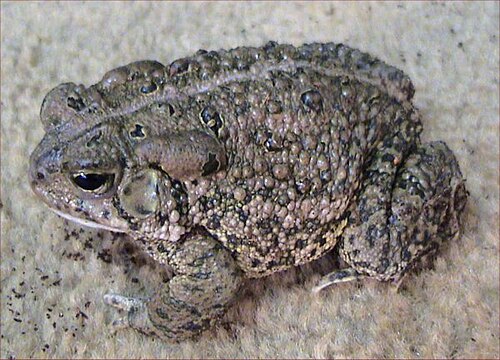
The Great Plains toad (Anaxyrus cognatus) is a relatively large species of true toad native to central North America. The amphibian is native throughout the Canadian Prairies (northern Great Plains) in southern Alberta, Manitoba, and Saskatchewan; and into northern Mexico in the Sonoran Desert and Mexican Plateau.
The Great Plains toad is grey, brown, and green in color, with darker colored blotching. It can grow to anywhere between 5.1 and 11.4 cm (2 and 4.5 in) in length. Its primary diet is various species of cutworms. It prefers grassland habitat with loose soil that is easy to burrow in. Breeding occurs throughout the spring and summer months, most often immediately after heavy rainfall. In dry areas it may only emerge from its burrow for a few weeks when conditions are right, and usually at night, but in areas with permanent water bodies and abundant rain it may be active all day. Its mating call is a very loud, harsh chirping noise repeated many times, very fast.
The great plains toad feeds a range of insects such as lepidopterans, dipterans, hymenopterans, coleopterans, ants, and termites. The toad is preyed upon by the plains... Wikipedia →
Closest Relatives at Saguaro National Park

Red-spotted Toad
Anaxyrus punctatus
Woodhouse's Toad
Anaxyrus woodhousii

Colorado River Toad
Incilius alvarius

Canyon Tree Frog
Dryophytes arenicolor

American Bullfrog
Lithobates catesbeianus

Couch's Spadefoot
Scaphiopus couchii

Lowland Leopard Frog
Lithobates yavapaiensis

Mexican Spadefoot
Spea multiplicata

African Clawed Frog
Xenopus laevis
Global Distribution
Where this species is recorded worldwide. Restricted to human observations from 2019 onwards — the same kind of record and the same period the probabilities on this page are built from, so collar-tracking studies, camera-trap arrays and museum specimens are excluded. Around Santa Rosa that removes 5,924 GPS fixes from a handful of tagged jaguars.
where this species is recorded (GBIF density — it tracks where observers go, not how likely a sighting is) · parks where it occurs — tap a pin for the sighting probability there
Parks Where Found
| # | Park | Country | Daily sighting probability |
|---|---|---|---|
| 1 | Badlands National Park | 🇺🇸 United States | |
| 2 | Saguaro National Park | 🇺🇸 United States | |
| 3 | Guadalupe Mountains National Park | 🇺🇸 United States | |
| 4 | Joshua Tree National Park | 🇺🇸 United States |
Quick answers
What are the chances of seeing a Great Plains Toad in Saguaro National Park?
About 10% of wildlife watchers report a Great Plains Toad sighting in Saguaro National Park, based on 48 verified sightings from GBIF citizen-science data.
When is the best time to see Great Plains Toad in Saguaro National Park?
August has the highest sighting rate for Great Plains Toad in Saguaro National Park in our monthly data.