
Mexican Spadefoot
Spea multiplicata
- KingdomAnimalia (Animals)
- PhylumChordata (Chordates)
- ClassAmphibia (Amphibians)
- OrderAnura (Frogs and Toads)
- FamilyScaphiopodidae (North American Spadefoots)
- GenusSpea (Western Spadefoots)
- SpeciesSpea multiplicata (Mexican Spadefoot)
About the Mexican Spadefoot
The New Mexico spadefoot toad (Spea multiplicata) is a species of American spadefoot toad found in the southwestern United States and Mexico. Like other species of spadefoot toad, they get their name from a distinctive spade-like projections on their hind legs, which enable them to dig in sandy soils. Spea multiplicata can be identified by its wedge-shaped spade. Some sources also refer to the species as the Mexican spadefoot toad, desert spadefoot toad or southern spadefoot toad.
The New Mexico spadefoot toad has a length of 1.5 to 2.5 inches (3.8 to 6.4 cm) with a round body and relatively short legs. They weigh between 1.7 and 3.5 ounces (48 and 99 g). They are green, to grey, to brown, usually reflecting the soil color of their native habitat, often with black and orange colored speckling on their back, and a white underside. They have large eyes, with vertical pupils.
Like all species of spadefoot toad, the New Mexico spadefoot toad is nocturnal and secretive. If handled, these frogs might emit a peanut-like odor, which can cause tearing and nasal discharge if in close contact with the face. Spending most of its time buried in the ground, the spadefoot... Wikipedia →
Closest Relatives at Saguaro National Park

Couch's Spadefoot
Scaphiopus couchii

Red-spotted Toad
Anaxyrus punctatus

Colorado River Toad
Incilius alvarius

Canyon Tree Frog
Dryophytes arenicolor

American Bullfrog
Lithobates catesbeianus

Lowland Leopard Frog
Lithobates yavapaiensis

Great Plains Toad
Anaxyrus cognatus
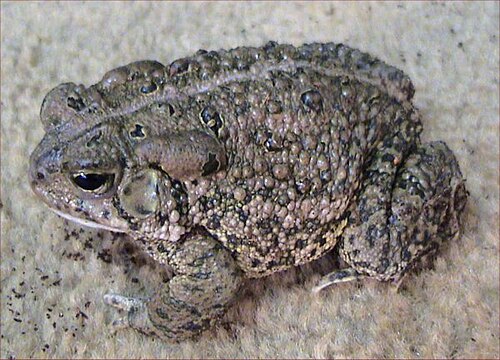
Woodhouse's Toad
Anaxyrus woodhousii

African Clawed Frog
Xenopus laevis
Global Distribution
Where this species is recorded worldwide. Restricted to human observations from 2019 onwards — the same kind of record and the same period the probabilities on this page are built from, so collar-tracking studies, camera-trap arrays and museum specimens are excluded. Around Santa Rosa that removes 5,924 GPS fixes from a handful of tagged jaguars.
where this species is recorded (GBIF density — it tracks where observers go, not how likely a sighting is) · parks where it occurs — tap a pin for the sighting probability there
Parks Where Found
| # | Park | Country | Daily sighting probability |
|---|---|---|---|
| 1 | Big Bend National Park | 🇺🇸 United States | |
| 2 | Saguaro National Park | 🇺🇸 United States |