


Peach-faced Lovebird
Agapornis roseicollis
- KingdomAnimalia (Animals)
- PhylumChordata (Chordates)
- ClassAves (Birds)
- OrderPsittaciformes (Parrots)
- FamilyPsittacidae (New World and African Parrots)
- GenusAgapornis (Lovebirds)
- SpeciesAgapornis roseicollis (Peach-faced Lovebird)
About the Peach-faced Lovebird
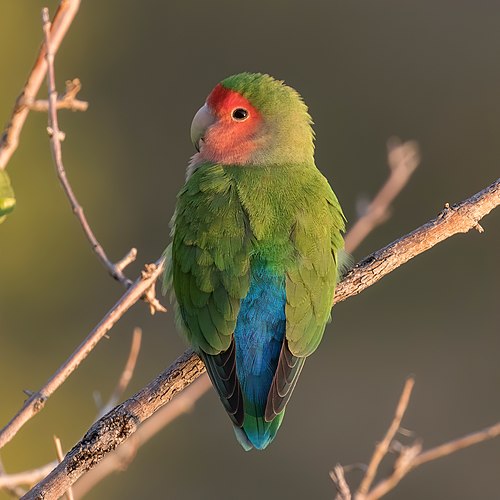
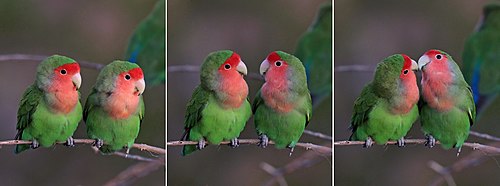
The rosy-faced lovebird (Agapornis roseicollis), also known as the rosy-collared or peach-faced lovebird, is a species of lovebird native to the Namibian savanna woodlands. Loud and constant chirpers, these birds are very social animals and often congregate in small groups in the wild. They eat throughout the day and take frequent baths. Coloration can vary widely among populations. Plumage is identical in males and females. Lovebirds are renowned for their sleep position in which they sit side-by-side and turn their faces in towards each other. Also, females are well noted to tear raw materials into long strips, "twisty-tie" them onto their backs, and fly substantial distances back to make a nest. These birds are common in the pet industry.
It was described by the French ornithologist Louis Pierre Vieillot in 1818. It was originally named Psittacus roseicollis but later moved to the genus Agapornis with the other lovebirds. Two subspecies are recognised: Agapornis roseicollis, (Vieillot, 1818)
Agapornis roseicollis catumbella, B.P. Hall, 1952 - Angola Agapornis roseicollis roseicollis, (Vieillot 1818) - Namibia, Botswana, and South Africa The rosy... Wikipedia →
Closest Relatives at Saguaro National Park


Global Distribution
Where this species is recorded worldwide. Restricted to human observations from 2019 onwards — the same kind of record and the same period the probabilities on this page are built from, so collar-tracking studies, camera-trap arrays and museum specimens are excluded. Around Santa Rosa that removes 5,924 GPS fixes from a handful of tagged jaguars.
where this species is recorded (GBIF density — it tracks where observers go, not how likely a sighting is) · parks where it occurs — tap a pin for the sighting probability there
Parks Where Found
| # | Park | Country | Daily sighting probability |
|---|---|---|---|
| 1 | Waterberg Plateau Park | 🇳🇦 Namibia | |
| 2 | Namib-Naukluft National Park | 🇳🇦 Namibia | |
| 3 | Etosha National Park | 🇳🇦 Namibia | |
| 4 | Saguaro National Park | 🇺🇸 United States | |
| 5 | Sierra Nevada National Park | 🇪🇸 Spain | |
| 6 | Kruger National Park | 🇿🇦 South Africa | |
| 7 | Kgalagadi Transfrontier Park | 🇿🇦 South Africa | |
| 8 | Addo Elephant National Park | 🇿🇦 South Africa | |
| 9 | Ciénaga de Zapata | 🇨🇺 Cuba | |
| 10 | Everglades National Park | 🇺🇸 United States | |
| 11 | Monfragüe National Park | 🇪🇸 Spain | |
| 12 | Pyrénées National Park | 🇫🇷 France |
Quick answers
What are the chances of seeing a Peach-faced Lovebird in Saguaro National Park?
Under 5% of wildlife watchers report a Peach-faced Lovebird sighting in Saguaro National Park, based on 11 verified sightings from GBIF citizen-science data.
When is the best time to see Peach-faced Lovebird in Saguaro National Park?
April has the highest sighting rate for Peach-faced Lovebird in Saguaro National Park in our monthly data.