


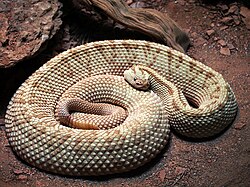

Central American Rattlesnake
Crotalus simus
Silhouette: Bill Bouton (source photo) & T. Michael Keesey (vectorization) · PhyloPic
- KingdomAnimalia (Animals)
- PhylumChordata (Chordates)
- ClassSquamata
- FamilyViperidae (Vipers)
- GenusCrotalus (Rattlesnakes)
- SpeciesCrotalus simus (Central American Rattlesnake)
About the Central American Rattlesnake
Common names: Middle American rattlesnake, Central American rattlesnake, tzabcan (local name for subspecies C. s. tzabcan) Crotalus simus is a venomous pit viper species found in Mexico and Central America. The specific epithet is Latin for "flat-nosed", likely because its head is blunt compared with lanceheads (Bothrops).
Adults commonly exceed 130 cm (51 in) in length, with males growing larger than females. Large males reach 140–160 cm (55–63 in) in some populations. The maximum length is 180 cm (71 in). The body has a rough appearance because the dorsal scale keels are accentuated into protuberances or tuberculations. This is most apparent on the scale rows on either side of the body with a decreasing intensity in the lower rows. The vertebral scales are about as prominently keeled as the fourth row down on the flanks (with the vertebral scales as the first row).
The species is found from Mexico in southwestern Michoacán on the Pacific coast, and Veracruz and the Yucatan Peninsula on the Atlantic coast, south through Belize, Guatemala, El Salvador, Honduras, and Nicaragua to west-central Costa Rica. It is absent from Panama, but apparently... Wikipedia →
Recent sightings of Central American Rattlesnake in Santa Rosa National Park
LIVEiNaturalistClosest Relatives at Santa Rosa National Park


Global Distribution
Warmer areas are where this animal is recorded most often.
Parks Where Found
| # | Park | Country | Daily sighting probability |
|---|---|---|---|
| 1 | Santa Rosa National Park | 🇨🇷 Costa Rica | |
| 2 | Celaque National Park | 🇭🇳 Honduras | |
| 3 | Rincón de la Vieja National Park | 🇨🇷 Costa Rica | |
| 4 | Palo Verde National Park | 🇨🇷 Costa Rica | |
| 5 | Ostional Wildlife Refuge | 🇨🇷 Costa Rica | |
| 6 | Cañón del Sumidero National Park | 🇲🇽 Mexico |
Quick answers
What are the chances of seeing a Central American Rattlesnake in Santa Rosa National Park?
About 40% of wildlife watchers report a Central American Rattlesnake sighting in Santa Rosa National Park, based on 39 verified sightings from GBIF citizen-science data.
When is the best time to see Central American Rattlesnake in Santa Rosa National Park?
February has the highest sighting rate for Central American Rattlesnake in Santa Rosa National Park in our monthly data.