

Wagner's moustached bat
Pteronotus personatus
Silhouette: T. Michael Keesey · PhyloPic
- KingdomAnimalia (Animals)
- PhylumChordata (Chordates)
- ClassMammalia (Mammals)
- OrderChiroptera (Bats)
- FamilyMormoopidae (Ghost-faced and Moustached Bats)
- GenusPteronotus (Moustached Bats)
- SpeciesPteronotus personatus (Wagner's moustached bat)
About the Wagner's moustached bat
Wagner's mustached bat (Pteronotus personatus) is a bat species from South and Central America. It is one of the few New World bats species known to perform Doppler shift compensation behavior. Wagner's mustached bat is a relatively small bat, with a head-body length of 6 to 6.7 centimetres (2.4 to 2.6 in) and a tail 1.5 to 1.8 centimetres (0.59 to 0.71 in) long. There are two color phases, with some individuals having blackish-brown fur over the back and head with drab grey underparts, and others being clay-brown to reddish yellow with buff or cinnamon underparts. Individuals of both color phases can be found together in the same cave.
The ears are long and pointed, with sharp serrations along the medial edges and a spatulate tragus including a shelf-like fold. The upper lip has a number of heavy bristles and surrounds the nose, with numerous folds and small projections along its edge. The snout is raised upwards, while the remainder of the skull is relatively flattened. The incisor teeth are reduced in size, but have a complex shape with two or three lobes.
The wing membranes reach the ankles of the bat, which are also attached to a large uropatagium, with the short... Wikipedia →
Recent sightings of Wagner's moustached bat in Santa Rosa National Park
LIVEiNaturalistClosest Relatives at Santa Rosa National Park

 Greater Bulldog Bat
Noctilio leporinus

Greater Sac-winged Bat
Saccopteryx bilineata

 Pallas's Long-tongued Bat
Glossophaga soricina
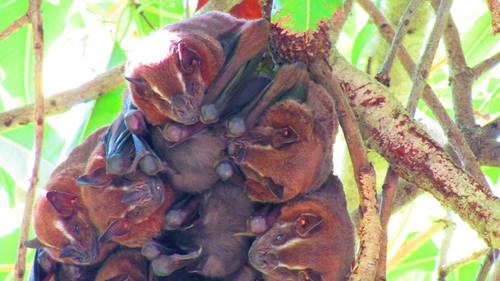
 Great Fruit-eating Bat
Artibeus lituratus

Espirito Santo Free-tailed Bat
Nyctinomops laticaudatus

Pallas' Free-tailed Bat
Molossus molossus

 Seba's Short-tailed Bat
Carollia perspicillata

Vampire Bat
Desmodus rotundus

Yellow-throated Big-eared Bat
Lampronycteris brachyotis

Jamaican Fruit-eating Bat
Artibeus jamaicensis

Thomas's Fruit-eating Bat
Artibeus watsoni
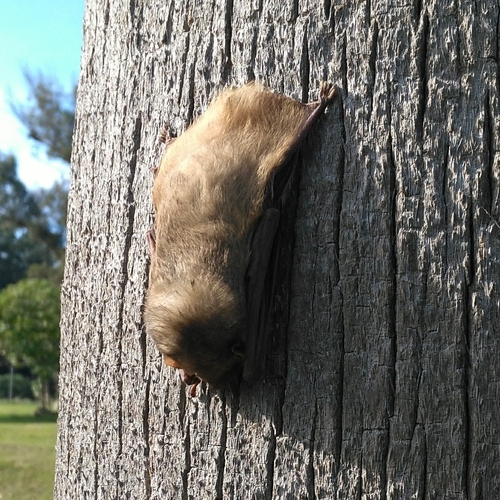
 Southern Yellow Bat
Dasypterus ega
Global Distribution
Warmer areas are where this animal is recorded most often.
Parks Where Found
| # | Park | Country | Daily sighting probability |
|---|---|---|---|
| 1 | Santa Rosa National Park | 🇨🇷 Costa Rica |
More parks will be added in future updates.