


Common Tree Frog
Polypedates leucomystax
- KingdomAnimalia (Animals)
- PhylumChordata (Chordates)
- ClassAmphibia (Amphibians)
- OrderAnura (Frogs and Toads)
- FamilyRhacophoridae (Old World Tree Frogs)
- GenusPolypedates (whipping frogs)
- SpeciesPolypedates leucomystax (Common Tree Frog)
About the Common Tree Frog
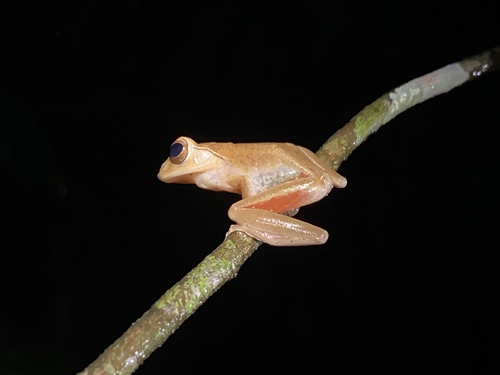
Polypedates leucomystax is a species in the shrub frog family Rhacophoridae. It is known under numerous common names, including common tree frog, four-lined tree frog, golden tree frog or striped tree frog. Many past authors have united it with the common Indian tree frog in P. maculatus (or Rhacophorus maculatus, as was common in older times), but today they are generally considered distinct species. In its native range, it is also called "white-lipped tree frog", but this name is otherwise applied to a species of true tree frogs (family Hylidae).
Polypedates leucomystax is not considered a threatened species by the IUCN. It is, in fact a species complex containing various cryptic species within it. Previously, P. leucomystex was thought to distribute below the Red River of Vietnam and in western Yunnan, while P. megacephalus can be found above the Red River and in Northeast India. However, recent genetic studies revealed that the natural barriers between these species are the Isthmus of Kra and the Tenasserim Range, where P. leucomystax can be found below the isthmus and west of the range.
The Polypedates leucomystax complex began diverging during the Pliocene, and spread... Wikipedia →
Closest Relatives at Sepilok

Brown-Striped Tree Frog
Polypedates macrotis

File-eared Tree Frog
Polypedates otilophus

Harlequin Tree Frog
Rhacophorus pardalis

Chasen's Frilled Tree Frog
Kurixalus chaseni

Peter's Tree Frog
Nyctixalus pictus

Brown Tree Frog
Leptomantis harrissoni
Malaysian Flying Frog
Leptomantis rufipes
Banded Tree Frog
Leptomantis fasciatus

Common Indian Toad
Duttaphrynus melanostictus

Rough-sided frog
Pulchrana glandulosa

Green Paddy Frog
Hylarana erythraea

Lowland Litter Frog
Leptobrachium abbotti
Global Distribution
Where this species is recorded worldwide. Restricted to human observations from 2019 onwards — the same kind of record and the same period the probabilities on this page are built from, so collar-tracking studies, camera-trap arrays and museum specimens are excluded. Around Santa Rosa that removes 5,924 GPS fixes from a handful of tagged jaguars.
where this species is recorded (GBIF density — it tracks where observers go, not how likely a sighting is) · parks where it occurs — tap a pin for the sighting probability there
Parks Where Found
| # | Park | Country | Daily sighting probability |
|---|---|---|---|
| 1 | Khao Sok National Park | 🇹🇭 Thailand | |
| 2 | Bako National Park | 🇲🇾 Malaysia | |
| 3 | Bali Barat National Park | 🇮🇩 Indonesia | |
| 4 | Gunung Leuser National Park | 🇮🇩 Indonesia | |
| 5 | Khao Luang National Park | 🇹🇭 Thailand | |
| 6 | Kerinci Seblat National Park | 🇮🇩 Indonesia | |
| 7 | Kinabalu Park | 🇲🇾 Malaysia | |
| 8 | Danum Valley Conservation Area | 🇲🇾 Malaysia | |
| 9 | Kinabatangan Wildlife Sanctuary | 🇲🇾 Malaysia | |
| 10 | Sepilok | 🇲🇾 Malaysia | |
| 11 | Way Kambas National Park | 🇮🇩 Indonesia | |
| 12 | Taman Negara National Park | 🇲🇾 Malaysia |
Quick answers
What are the chances of seeing a Common Tree Frog in Sepilok?
About 10% of wildlife watchers report a Common Tree Frog sighting in Sepilok, based on 12 verified sightings from GBIF citizen-science data.
When is the best time to see Common Tree Frog in Sepilok?
October has the highest sighting rate for Common Tree Frog in Sepilok in our monthly data.