


Plantain Squirrel
Callosciurus notatus
- KingdomAnimalia (Animals)
- PhylumChordata (Chordates)
- ClassMammalia (Mammals)
- OrderRodentia (Rodents)
- FamilySciuridae (Squirrels)
- GenusCallosciurus (Beautiful Squirrels)
- SpeciesCallosciurus notatus (Plantain Squirrel)
About the Plantain Squirrel
The plantain squirrel, oriental squirrel or tricoloured squirrel (Callosciurus notatus) is a species of rodent in the family Sciuridae found in Indonesia, Malaysia, Singapore, and Thailand in a wide range of habitats: forests, mangroves, parks, gardens, and agricultural areas. Fruit farmers consider them to be pests.
Its body is about 20–30 cm (8–12 in) long with a similar-sized tail. Its weight can vary from 160 to 259 g (5.6 to 9.1 oz). It is greyish/brown with a chestnut belly and a black and white stripe on the side. It is very quick and agile in trees, able to jump a few metres between trees, and rarely wanders on the ground.
Like all rodents, it has two large upper and lower incisors. Its chestnut belly easily distinguishes it from the similar black-striped squirrel, which has a grey belly. The plantain squirrel is diurnal. It is either solitary or social in small groups, wherein squirrels communicate with shrill chirps and chattering while showing off their tails. These high calls may be alarms responding to the presence of a predator. Different types of predators prompt different calls and elicit different responses in the squirrel. A snake... Wikipedia →
Closest Relatives at Sepilok

Prevost's Squirrel
Callosciurus prevostii

Ear-spot Squirrel
Callosciurus adamsi

Red Giant Flying Squirrel
Petaurista petaurista

Pale Giant Squirrel
Ratufa affinis

Least Pygmy Squirrel
Exilisciurus exilis

Black Flying Squirrel
Aeromys tephromelas

Low's Squirrel
Sundasciurus lowii

Thomas's Flying Squirrel
Aeromys thomasi
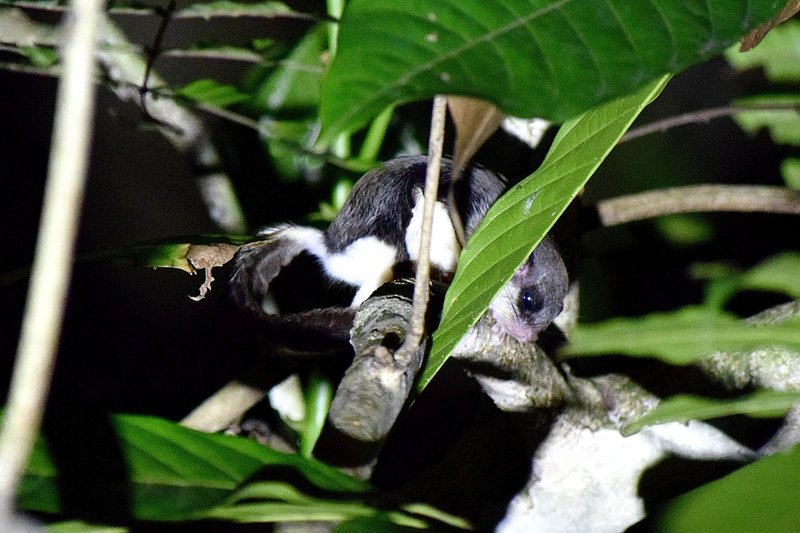
Hose's Pygmy Flying Squirrel
Petaurillus hosei
Global Distribution
Where this species is recorded worldwide. Restricted to human observations from 2019 onwards — the same kind of record and the same period the probabilities on this page are built from, so collar-tracking studies, camera-trap arrays and museum specimens are excluded. Around Santa Rosa that removes 5,924 GPS fixes from a handful of tagged jaguars.
where this species is recorded (GBIF density — it tracks where observers go, not how likely a sighting is) · parks where it occurs — tap a pin for the sighting probability there
Parks Where Found
| # | Park | Country | Daily sighting probability |
|---|---|---|---|
| 1 | Bako National Park | 🇲🇾 Malaysia | |
| 2 | Bali Barat National Park | 🇮🇩 Indonesia | |
| 3 | Tanjung Puting National Park | 🇮🇩 Indonesia | |
| 4 | Kinabatangan Wildlife Sanctuary | 🇲🇾 Malaysia | |
| 5 | Sepilok | 🇲🇾 Malaysia | |
| 6 | Gunung Leuser National Park | 🇮🇩 Indonesia | |
| 7 | Taman Negara National Park | 🇲🇾 Malaysia | |
| 8 | Kerinci Seblat National Park | 🇮🇩 Indonesia | |
| 9 | Kinabalu Park | 🇲🇾 Malaysia | |
| 10 | Way Kambas National Park | 🇮🇩 Indonesia | |
| 11 | Khao Luang National Park | 🇹🇭 Thailand | |
| 12 | Danum Valley Conservation Area | 🇲🇾 Malaysia | |
| 13 | Khao Sok National Park | 🇹🇭 Thailand |
Quick answers
What are the chances of seeing a Plantain Squirrel in Sepilok?
About 30% of wildlife watchers report a Plantain Squirrel sighting in Sepilok, based on 34 verified sightings from GBIF citizen-science data.
When is the best time to see Plantain Squirrel in Sepilok?
April has the highest sighting rate for Plantain Squirrel in Sepilok in our monthly data.