


Spotted House Gecko
Gekko monarchus
- KingdomAnimalia (Animals)
- PhylumChordata (Chordates)
- ClassSquamata
- FamilyGekkonidae (Typical Geckos)
- GenusGekko (Calling Geckos)
- SpeciesGekko monarchus (Spotted House Gecko)
About the Spotted House Gecko
Gekko monarchus, also called the spotted house gecko, is a species of gecko found in the Malay Peninsula (including southern Thailand and Singapore), some smaller Malaysian islands, Borneo (Brunei, East Malaysia and Kalimantan), the Philippines, many Indonesian islands including Sumatra, Java, Sulawesi, and New Guinea (Irian Jaya and Papua New Guinea).
This lizard has the typical body build of the genus Gekko - it appears flat and has a rough skin with small bumps on its back. Their tails regenerate once dropped, as with most gecko species. The regenerated tail will never look the same as the original (it has a different texture and slightly odd color).
Similar to common house geckos and dtellas, males make quiet clicking sounds when courting a female; both sexes are capable of chirping and "barking". When startled or alarmed, the gecko waves its tail quickly and may breathe heavily, making a sound not unlike hissing.
They have a W spot on the backs of their heads, typical for this species. Monarch geckos are strictly insectivorous, feeding on various types of insects (roaches, crickets, flies, spiders, even wasps). Wikipedia →
Closest Relatives at Sepilok

White-banded Narrow-disked Gecko
Gekko albofasciolatus

Horsfield's Flying Gecko
Gekko horsfieldii

Gliding gecko
Gekko kuhli
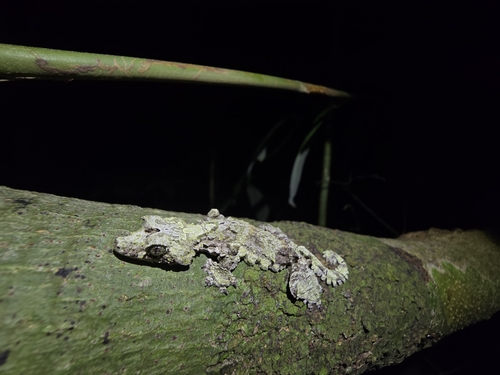
Sabah Flying Gecko
Gekko rhacophorus

Flat-tailed House Gecko
Hemidactylus platyurus

Common House Gecko
Hemidactylus frenatus
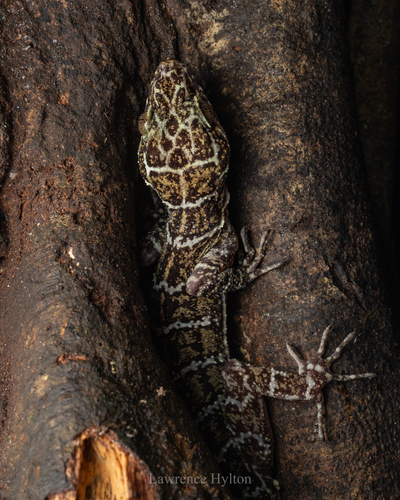
Borneo Bow-fingered Gecko
Cyrtodactylus malayanus

Mutilating Gecko
Gehyra mutilata

Frilled Gecko
Hemidactylus craspedotus

Common Dwarf Gecko
Hemiphyllodactylus typus
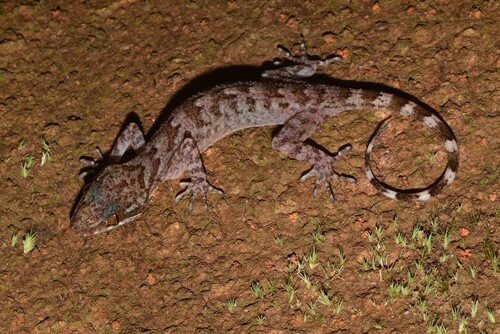
Sabah Lowland Bent-toed Gecko
Cyrtodactylus yoshii
Global Distribution
Where this species is recorded worldwide. Restricted to human observations from 2019 onwards — the same kind of record and the same period the probabilities on this page are built from, so collar-tracking studies, camera-trap arrays and museum specimens are excluded. Around Santa Rosa that removes 5,924 GPS fixes from a handful of tagged jaguars.
where this species is recorded (GBIF density — it tracks where observers go, not how likely a sighting is) · parks where it occurs — tap a pin for the sighting probability there
Parks Where Found
| # | Park | Country | Daily sighting probability |
|---|---|---|---|
| 1 | Bako National Park | 🇲🇾 Malaysia | |
| 2 | Danum Valley Conservation Area | 🇲🇾 Malaysia | |
| 3 | Kerinci Seblat National Park | 🇮🇩 Indonesia | |
| 4 | Taman Negara National Park | 🇲🇾 Malaysia | |
| 5 | Kinabalu Park | 🇲🇾 Malaysia | |
| 6 | Sepilok | 🇲🇾 Malaysia | |
| 7 | Kinabatangan Wildlife Sanctuary | 🇲🇾 Malaysia | |
| 8 | Gunung Leuser National Park | 🇮🇩 Indonesia | |
| 9 | Tanjung Puting National Park | 🇮🇩 Indonesia | |
| 10 | Tangkoko Nature Reserve | 🇮🇩 Indonesia |
Quick answers
What are the chances of seeing a Spotted House Gecko in Sepilok?
About 30% of wildlife watchers report a Spotted House Gecko sighting in Sepilok, based on 50 verified sightings from GBIF citizen-science data.
When is the best time to see Spotted House Gecko in Sepilok?
January has the highest sighting rate for Spotted House Gecko in Sepilok in our monthly data.