

Cope's Gray Tree Frog
Dryophytes chrysoscelis
Silhouette: Robbi Bishop-Taylor · PhyloPic
- KingdomAnimalia (Animals)
- PhylumChordata (Chordates)
- ClassAmphibia (Amphibians)
- OrderAnura (Frogs and Toads)
- FamilyHylidae (Hylid Tree Frogs)
- GenusDryophytes
- SpeciesDryophytes chrysoscelis (Cope's Gray Tree Frog)
About the Cope's Gray Tree Frog
Cope's gray treefrog (Dryophytes chrysoscelis) is a species of treefrog found in the United States and Canada. It is almost indistinguishable from the gray treefrog (Dryophytes versicolor), and shares much of its geographic range. Both species are variable in color, mottled gray to gray-green, resembling the bark of trees. These are treefrogs of woodland habitats, though they will sometimes travel into more open areas to reach a breeding pond. The only readily noticeable difference between the two species is the mating call — Cope's has a faster-paced and slightly higher-pitched call than D. versicolor. In addition, D. chrysoscelis is reported to be slightly smaller, more arboreal, and more tolerant of dry conditions than D. versicolor.
Edward Drinker Cope described the species in 1880. The specific name, chrysoscelis, is from Greek chrysos, gold, and scelis, leg. Microscopic inspection of the chromosomes of D. chrysoscelis and D. versicolor reveals differences in chromosome number. D. chrysoscelis is diploid, having two complete sets of chromosomes, the usual condition in vertebrates. D. versicolor is tetraploid, having double the usual number of chromosomes. Generally... Wikipedia →
Recent sightings of Cope's Gray Tree Frog in Shenandoah National Park
LIVEiNaturalistClosest Relatives at Shenandoah National Park

 Gray Treefrog Species Complex
Dryophytes versicolor

 Northern Cricket Frog
Acris crepitans

 Spring Peeper
Pseudacris crucifer

Upland Chorus Frog
Pseudacris feriarum

 American Toad
Anaxyrus americanus

 Pickerel Frog
Lithobates palustris
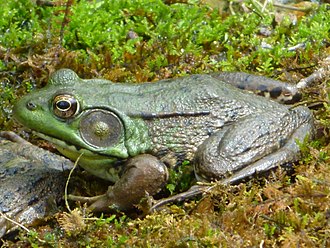
Green Frog
Lithobates clamitans

Fowler's Toad
Anaxyrus fowleri

 American Bullfrog
Lithobates catesbeianus

Wood Frog
Lithobates sylvaticus

 Eastern Spadefoot
Scaphiopus holbrookii
Global Distribution
Warmer areas are where this animal is recorded most often.
Parks Where Found
| # | Park | Country | Daily sighting probability |
|---|---|---|---|
| 1 | Congaree National Park | 🇺🇸 United States | |
| 2 | Shenandoah National Park | 🇺🇸 United States |