


American Bullfrog
Lithobates catesbeianus
Silhouette: Chuanixn Yu · PhyloPic
- KingdomAnimalia (Animals)
- PhylumChordata (Chordates)
- ClassAmphibia (Amphibians)
- OrderAnura (Frogs and Toads)
- FamilyRanidae (Typical Frogs)
- GenusLithobates (American Water Frogs)
- SpeciesLithobates catesbeianus (American Bullfrog)
About the American Bullfrog
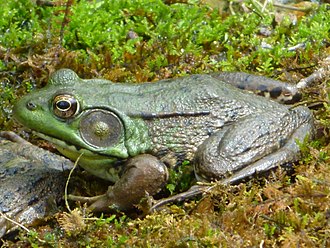
The American bullfrog (Lithobates catesbeianus), often simply known as the bullfrog in Canada and the United States, is a species of large frog in the family Ranidae (true frogs). The species is native to eastern North America. It typically inhabits large permanent water bodies such as swamps, ponds, and lakes. The bullfrog can also be found in manmade habitats such as pools, koi ponds, canals, ditches, reservoirs and culverts. The bullfrog gets its common name from the sound the male makes during the breeding season, which sounds similar to a bull bellowing. It is a generalist carnivore, consuming a wide variety of prey. In turn, it is eaten by predators such as alligators, snakes, and birds.
The bullfrog is large and is commonly eaten by humans throughout its range, especially in the southern United States where it is plentiful. Its use as a food source has led to the bullfrog being introduced outside of its native range. The bullfrog has been introduced in more than 40 countries and many continents including the Western United States, the Caribbean, South America, Western Europe, Belgium, Italy, Spain, Greece, China, Japan, South Korea, Malaysia, Southeast Asia, and more. In these places it is considered an invasive species due to its voracious appetite and the large number of eggs it produces, which has a negative effect on native amphibians, certain insects and other fauna. The bullfrog is very skittish, which can make its capture difficult, and thus it often becomes established.
Other than for food, the bullfrog is also used for dissection in science classes. Albino bullfrogs are sometimes kept as pets, and bullfrog tadpoles are often sold at ponds or fish stores. Wikipedia →
Recent sightings of American Bullfrog in Shenandoah National Park
LIVEiNaturalistClosest Relatives at Shenandoah National Park

 Pickerel Frog
Lithobates palustris
Green Frog
Lithobates clamitans

Wood Frog
Lithobates sylvaticus

 American Toad
Anaxyrus americanus

 Gray Treefrog Species Complex
Dryophytes versicolor

Fowler's Toad
Anaxyrus fowleri

 Northern Cricket Frog
Acris crepitans

 Spring Peeper
Pseudacris crucifer

 Eastern Spadefoot
Scaphiopus holbrookii

 Cope's Gray Tree Frog
Dryophytes chrysoscelis

Upland Chorus Frog
Pseudacris feriarum
Global Distribution
Warmer areas are where this animal is recorded most often.
Parks Where Found
| # | Park | Country | Daily sighting probability |
|---|---|---|---|
| 1 | Acadia National Park | 🇺🇸 United States | |
| 2 | Saguaro National Park | 🇺🇸 United States | |
| 3 | Shenandoah National Park | 🇺🇸 United States | |
| 4 | Yosemite National Park | 🇺🇸 United States | |
| 5 | Point Pelee National Park | 🇨🇦 Canada | |
| 6 | Congaree National Park | 🇺🇸 United States | |
| 7 | El Vizcaíno Biosphere Reserve | 🇲🇽 Mexico | |
| 8 | Los Haitises National Park | 🇩🇴 Dominican Republic | |
| 9 | Reserva de la Biosfera Mariposa Monarca | 🇲🇽 Mexico | |
| 10 | Podocarpus National Park | 🇪🇨 Ecuador | |
| 11 | Joshua Tree National Park | 🇺🇸 United States |
Quick answers
What are the chances of seeing a American Bullfrog in Shenandoah National Park?
About 20% of wildlife watchers report a American Bullfrog sighting in Shenandoah National Park, based on 127 verified sightings from GBIF citizen-science data.
When is the best time to see American Bullfrog in Shenandoah National Park?
March has the highest sighting rate for American Bullfrog in Shenandoah National Park in our monthly data.