

Black Myotis
Myotis nigricans
Silhouette: Archibald Thorburn · PhyloPic
- KingdomAnimalia (Animals)
- PhylumChordata (Chordates)
- ClassMammalia (Mammals)
- OrderChiroptera (Bats)
- FamilyVespertilionidae (Evening Bats)
- GenusMyotis (Mouse-eared Bats)
- SpeciesMyotis nigricans (Black Myotis)
About the Black Myotis
The black myotis (Myotis nigricans) is a vesper bat species from South and Central America. Its body is dark brown/black. The head to body length, not including the tail, is about 5 cm (2 in.). The black myotis is a tiny bat with a small pointed non-noseleaf snout. Its ears are pointy and triangular, and extremely sensitive. Its forearm-like wings have single claws while its hind feet have five, and its torso is covered in a short hair layer.
The genus Myotis consists of more than 100 species worldwide, except the Antarctic. Specifically, Myotis nigricans is found in South Mexico (Veracruz, Oaxaca y Chiapas) to Peru, Bolivia, North Argentina, Paraguay, South Brazil, Trinidad and Tobago, and Lesser Antilles (St. Martin, Montserrat and Grenada). This bat species lives in spaces like tree barks, foliages, and the ceilings of buildings and houses. Myotis nigricans is able to cohabit with other species of its genus and share food and roosts. However, competition over food and roosts has been seen with other insectivorous bats.
Gestation lasts 60 days in Myotis nigricans. For the first 2 or 3 days after birth, the young remain in close proximity... Wikipedia →
Recent sightings of Black Myotis in Soberanía National Park
LIVEiNaturalistClosest Relatives at Soberanía National Park

 riparian myotis
Myotis riparius

 Thomas's Yellow Bat
Rhogeessa io

 Proboscis Bat
Rhynchonycteris naso

Common tent-making Bat
Uroderma bilobatum

 Greater Sac-winged Bat
Saccopteryx bilineata

 Jamaican Fruit-eating Bat
Artibeus jamaicensis

 fringe-lipped bat
Trachops cirrhosus

Seba's Short-tailed Bat
Carollia perspicillata
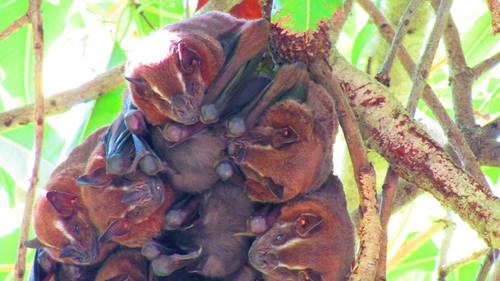
Great Fruit-eating Bat
Artibeus lituratus

Greater Spear-nosed Bat
Phyllostomus hastatus

Common Big-eared Bat
Micronycteris microtis
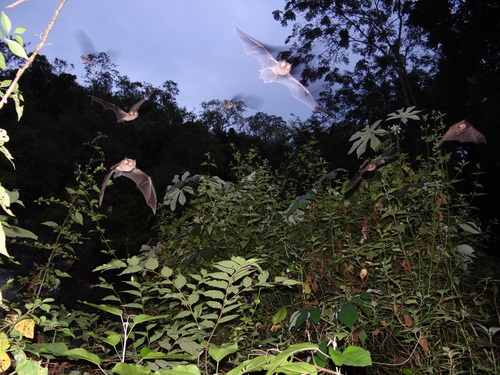
Mesoamerican Common Mustached Bat
Pteronotus mesoamericanus
Global Distribution
Warmer areas are where this animal is recorded most often.
Parks Where Found
| # | Park | Country | Daily sighting probability |
|---|---|---|---|
| 1 | Yasuní National Park | 🇪🇨 Ecuador | |
| 2 | Cuyabeno Wildlife Reserve | 🇪🇨 Ecuador | |
| 3 | Soberanía National Park | 🇵🇦 Panama |