


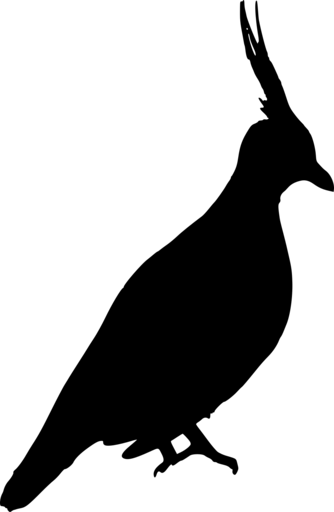
Crested Pigeon
Ocyphaps lophotes
Silhouette: Jarrad Barnes · PhyloPic
- KingdomAnimalia (Animals)
- PhylumChordata (Chordates)
- ClassAves (Birds)
- OrderColumbiformes (Pigeons and Doves)
- FamilyColumbidae (Pigeons and Doves)
- GenusOcyphaps (Crested Pigeons)
- SpeciesOcyphaps lophotes (Crested Pigeon)
About the Crested Pigeon
The crested pigeon (Ocyphaps lophotes) is a bird found widely throughout mainland Australia except for the far northern tropical areas. Only two Australian pigeon species possess an erect crest, the crested pigeon and the spinifex pigeon. The crested pigeon is the larger of the two species. The crested pigeon is sometimes referred to as a topknot pigeon, a common name shared with the reddish crested Lopholaimus antarcticus of Eastern Australia.
The species was described in 1822 by Temminck; it is the only species in the genus Ocyphaps, established by G.R. Gray in 1842. Two subspecies are recognized: O. l. lophotes, the nominate subspecies, occurring across the south of the continent; and O. l. whitlocki, occurring in regions of the centre and north of Western Australia. The taxon was named for F. Lawson Whitlock, who made important collections of bird specimens in those areas.
The species has also been placed as Geophaps, perhaps allied with Geophaps plumifera. Common names for the species, aside from crested or topknot pigeon, characterise them as a bronzewing or dove that is likewise distinguished by the crest.
The length of the crested pigeon varies... Wikipedia →
Recent sightings of Crested Pigeon in Springbrook National Park
LIVEiNaturalistClosest Relatives at Springbrook National Park

 Brown Cuckoo-Dove
Macropygia phasianella

Wonga Pigeon
Leucosarcia melanoleuca

Topknot Pigeon
Lopholaimus antarcticus

 White-headed Pigeon
Columba leucomela

Bar-shouldered Dove
Geopelia humeralis

 Wompoo Fruit Dove
Ptilinopus magnificus

Pacific Emerald Dove
Chalcophaps longirostris

Rose-crowned Fruit-Dove
Ptilinopus regina

 Common Bronzewing
Phaps chalcoptera

Peaceful Dove
Geopelia placida

 Pearl-necked Dove
Spilopelia chinensis
Global Distribution
Warmer areas are where this animal is recorded most often.
Parks Where Found
| # | Park | Country | Daily sighting probability |
|---|---|---|---|
| 1 | Uluru-Kata Tjuta National Park | 🇦🇺 Australia | |
| 2 | Ningaloo Marine Park | 🇦🇺 Australia | |
| 3 | Cape Range | 🇦🇺 Australia | |
| 4 | Flinders Ranges National Park | 🇦🇺 Australia | |
| 5 | Blue Mountains National Park | 🇦🇺 Australia | |
| 6 | Grampians National Park | 🇦🇺 Australia | |
| 7 | Noosa National Park | 🇦🇺 Australia | |
| 8 | Nitmiluk National Park | 🇦🇺 Australia | |
| 9 | Springbrook National Park | 🇦🇺 Australia | |
| 10 | Kosciuszko National Park | 🇦🇺 Australia | |
| 11 | Great Otway National Park | 🇦🇺 Australia | |
| 12 | Booderee National Park | 🇦🇺 Australia | |
| 13 | Royal National Park | 🇦🇺 Australia | |
| 14 | Wilsons Promontory National Park | 🇦🇺 Australia | |
| 15 | Lamington National Park | 🇦🇺 Australia | |
| 16 | Daintree National Park | 🇦🇺 Australia | |
| 17 | Kakadu National Park | 🇦🇺 Australia |
Quick answers
What are the chances of seeing a Crested Pigeon in Springbrook National Park?
About 10% of wildlife watchers report a Crested Pigeon sighting in Springbrook National Park, based on 16 verified sightings from GBIF citizen-science data.
When is the best time to see Crested Pigeon in Springbrook National Park?
July has the highest sighting rate for Crested Pigeon in Springbrook National Park in our monthly data.