


Ranoidea caerulea
Ranoidea caerulea
Silhouette: Vijay Karthick · PhyloPic
- KingdomAnimalia (Animals)
- PhylumChordata (Chordates)
- ClassAmphibia (Amphibians)
- OrderAnura (Frogs and Toads)
- FamilyPelodryadidae (Australasian Tree Frogs)
- GenusRanoidea
- SpeciesRanoidea caerulea
About the Ranoidea caerulea
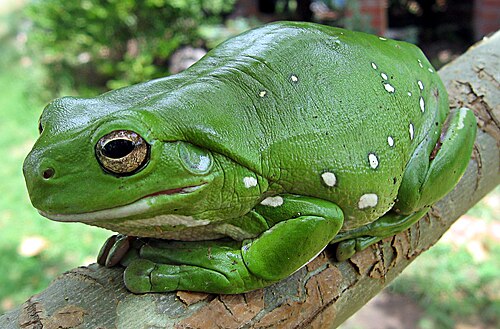
The Australian green tree frog (Pelodryas caerulea), also known as simply green tree frog in Australia, White's tree frog, or dumpy tree frog, is a species of tree frog native to Australia and New Guinea, with introduced populations in the United States and New Zealand, though the latter is believed to have died out. It is morphologically similar to some other members of its family, particularly the magnificent tree frog (P. splendida) and the white-lipped tree frog (Sandyrana infrafrenata).
Larger than most Australian frogs, the Australian green tree frog reaches 10 cm (4 in) or more in length. Its average lifespan in captivity, about 16 years, is long compared with most frogs. Docile and well suited to living near human dwellings, Australian green tree frogs are often found on window sills or inside houses, eating insects drawn by the light. The green tree frog screams when it is in danger to scare off its foe, and squeaks when it is touched.
Due to its appearance and behavioural traits, the green tree frog is a popular exotic pet throughout the world. The skin secretions of the frog have antibacterial and antiviral properties that may prove useful in pharmaceutical preparations and which have rendered it relatively immune to the population declines being experienced by many species of amphibian. It is a common species and the International Union for Conservation of Nature has assessed its conservation status as being "least concern". Wikipedia →
Recent sightings of Ranoidea caerulea in Springbrook National Park
LIVEiNaturalistClosest Relatives at Springbrook National Park

 Pearson's Green Tree Frog
Ranoidea pearsoniana

 Peron's Tree Frog
Litoria peronii

Eastern Dwarf Treefrog
Litoria fallax

Verreaux's Tree Frog
Litoria verreauxii

Broad-palmed Frog
Litoria latopalmata

Tyler's Tree Frog
Litoria tyleri

 Great Barred Frog
Mixophyes fasciolatus

 Eastern Cane Toad
Rhinella marina

 Tusked Frog
Adelotus brevis

Striped Marsh Frog
Limnodynastes peronii

Pouched Frog
Assa darlingtoni

Fleay's Barred Frog
Mixophyes fleayi
Global Distribution
Warmer areas are where this animal is recorded most often.
Parks Where Found
| # | Park | Country | Daily sighting probability |
|---|---|---|---|
| 1 | Litchfield National Park | 🇦🇺 Australia | |
| 2 | Kakadu National Park | 🇦🇺 Australia | |
| 3 | Nitmiluk National Park | 🇦🇺 Australia | |
| 4 | Lamington National Park | 🇦🇺 Australia | |
| 5 | Springbrook National Park | 🇦🇺 Australia | |
| 6 | Daintree National Park | 🇦🇺 Australia | |
| 7 | Noosa National Park | 🇦🇺 Australia | |
| 8 | Blue Mountains National Park | 🇦🇺 Australia |
Quick answers
What are the chances of seeing a Ranoidea caerulea in Springbrook National Park?
About 10% of wildlife watchers report a Ranoidea caerulea sighting in Springbrook National Park, based on 5 verified sightings from GBIF citizen-science data.
When is the best time to see Ranoidea caerulea in Springbrook National Park?
January has the highest sighting rate for Ranoidea caerulea in Springbrook National Park in our monthly data.