

Stephen's Banded Snake
Hoplocephalus stephensii
Silhouette: SeismicShrimp · PhyloPic
- KingdomAnimalia (Animals)
- PhylumChordata (Chordates)
- ClassSquamata
- FamilyElapidae (Elapid Snakes)
- GenusHoplocephalus (Hoplocephalus Snakes)
- SpeciesHoplocephalus stephensii (Stephen's Banded Snake)
About the Stephen's Banded Snake
Stephens's banded snake (Hoplocephalus stephensii) is a species of highly venomous tree snake in the family Elapidae. The species is endemic to Australia. Gerard Krefft described Hoplocephalus stephensii as a species new to science in 1869. The specific name stephensii, is in honour of Australian academic William John Stephens.
H. stephensii grows up to 1 meter (39 inches) in total length (including tail), with some specimens having been recorded as having a total length upwards of 120 cm (47 in). The Stephens' banded snake is the largest species within the genus Hoplocephalus, weighing up to 250 g (8.8 oz) as an adult. On average, females of this species are larger than males. This slight sexual dimorphism is an adaptation that likely improves the reproductive capabilities of females.
The anterior scalation of Stephens's banded snake consists of 21 rows of midbody dorsal scales, and 220 to 250 ventral scales. Posteriorly, its singular subcaudal scales can range between 50 and 70 scales from the anal plate to the tip of the tail. This species has a singular (undivided) anal plate that covers its cloacal opening. The ventral scales of the genus Hoplocephalus... Wikipedia →
Recent sightings of Stephen's Banded Snake in Springbrook National Park
LIVEiNaturalistClosest Relatives at Springbrook National Park

 Small-eyed Snake
Cryptophis nigrescens

Red-bellied Black Snake
Pseudechis porphyriacus

Dwarf Crowned Snake
Cacophis krefftii

Golden Crowned Snake
Cacophis squamulosus

Rough-scaled Snake
Tropidechis carinatus

Black-bellied Swamp Snake
Hemiaspis signata

Yellow-faced Whipsnake
Demansia psammophis

Bandy Bandy
Vermicella annulata

Eastern Brown Snake
Pseudonaja textilis

 Eastern Tiger Snake
Notechis scutatus
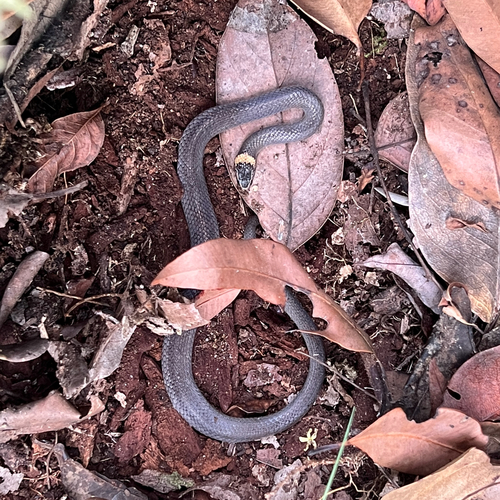
White-crowned Snake
Cacophis harriettae

Common Death Adder
Acanthophis antarcticus
Global Distribution
Warmer areas are where this animal is recorded most often.
Parks Where Found
| # | Park | Country | Daily sighting probability |
|---|---|---|---|
| 1 | Lamington National Park | 🇦🇺 Australia | |
| 2 | Springbrook National Park | 🇦🇺 Australia |