


Short-tailed Babbler
Pellorneum malaccense
- KingdomAnimalia (Animals)
- PhylumChordata (Chordates)
- ClassAves (Birds)
- OrderPasseriformes (Perching Birds)
- FamilyPellorneidae (Ground Babblers and Allies)
- GenusPellorneum (Typical Ground Babblers)
- SpeciesPellorneum malaccense (Short-tailed Babbler)
About the Short-tailed Babbler
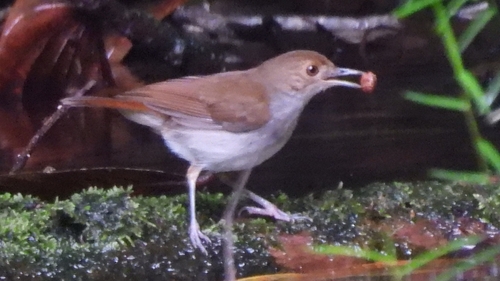
The mourning babbler (Pellorneum malaccense), previously the short-tailed babbler, is a species of bird in the ground babbler family Pellorneidae. It is found in the Malay Peninsula, Anambas Islands, Sumatra, Banyak Islands, Batu Islands, Riau Islands, Lingga Islands and the Natuna Islands. It was formerly considered to be conspecific with the glissando babbler (Pellorneum saturatum) and the leaflitter babbler (Pellorneum poliogene).
Its natural habitat is tropical moist lowland forests. The species is generally solitary, not joining larger mixed-species flocks, instead foraging as singles or pairs. They forage in the understory on the ground on a variety of insects including beetles, grasshoppers, and ants. Like other babblers they will use their foot to grasp food items, an unusual behaviour for passerine birds.
The mourning babbler is locally common at a number of places within its range but is considered near-threatened due to the loss of lowland forest in its range. The mourning babbler was formally described in 1844 by the German ornithologist Gustav Hartlaub. He placed it with the shortwings in the genus Brachypteryx and coined the binomial name Brachypteryx... Wikipedia →
Closest Relatives at Taman Negara National Park

Black-capped Babbler
Pellorneum capistratum

Puff-throated Babbler
Pellorneum ruficeps

Buff-breasted Babbler
Pellorneum tickelli

Abbott's Babbler
Malacocincla abbotti

Sooty-capped Babbler
Malacopteron affine

Rufous-crowned Babbler
Malacopteron magnum

Moustached Babbler
Malacopteron magnirostre

Ferruginous Babbler
Trichastoma bicolor

Scaly-crowned Babbler
Malacopteron cinereum
White-chested Babbler
Trichastoma rostratum

Brown Fulvetta
Alcippe brunneicauda

Horsfield's Babbler
Malacocincla sepiaria
Global Distribution
Where this species is recorded worldwide. Restricted to human observations from 2019 onwards — the same kind of record and the same period the probabilities on this page are built from, so collar-tracking studies, camera-trap arrays and museum specimens are excluded. Around Santa Rosa that removes 5,924 GPS fixes from a handful of tagged jaguars.
where this species is recorded (GBIF density — it tracks where observers go, not how likely a sighting is) · parks where it occurs — tap a pin for the sighting probability there
Parks Where Found
| # | Park | Country | Daily sighting probability |
|---|---|---|---|
| 1 | Khao Luang National Park | 🇹🇭 Thailand | |
| 2 | Danum Valley Conservation Area | 🇲🇾 Malaysia | |
| 3 | Taman Negara National Park | 🇲🇾 Malaysia | |
| 4 | Way Kambas National Park | 🇮🇩 Indonesia | |
| 5 | Sepilok | 🇲🇾 Malaysia | |
| 6 | Gunung Leuser National Park | 🇮🇩 Indonesia | |
| 7 | Kinabatangan Wildlife Sanctuary | 🇲🇾 Malaysia | |
| 8 | Kinabalu Park | 🇲🇾 Malaysia | |
| 9 | Tanjung Puting National Park | 🇮🇩 Indonesia | |
| 10 | Bako National Park | 🇲🇾 Malaysia | |
| 11 | Kerinci Seblat National Park | 🇮🇩 Indonesia | |
| 12 | Khao Sok National Park | 🇹🇭 Thailand |
Quick answers
What are the chances of seeing a Short-tailed Babbler in Taman Negara National Park?
About 10% of wildlife watchers report a Short-tailed Babbler sighting in Taman Negara National Park, based on 249 verified sightings from GBIF citizen-science data.
When is the best time to see Short-tailed Babbler in Taman Negara National Park?
September has the highest sighting rate for Short-tailed Babbler in Taman Negara National Park in our monthly data.