


White-headed Stilt
Himantopus leucocephalus
- KingdomAnimalia (Animals)
- PhylumChordata (Chordates)
- ClassAves (Birds)
- OrderCharadriiformes (Shorebirds and Allies)
- FamilyRecurvirostridae (Stilts and Avocets)
- GenusHimantopus (Typical Stilts)
- SpeciesHimantopus leucocephalus (White-headed Stilt)
About the White-headed Stilt
The pied stilt (Himantopus leucocephalus), also known as the white-headed stilt, is a shorebird in the family Recurvirostridae. It is widely distributed with a large total population size and apparently stable population trend, occurring in Malaysia, Japan, the Philippines, Brunei, Christmas Island, Indonesia, Palau, Papua New Guinea, Australia, and New Zealand. It is listed as Least Concern on the IUCN Red List. It is sometimes considered a subspecies of the black-winged stilt (H. himantopus).
Himantopus leucocephalus was the scientific name proposed by John Gould in 1837 who described a pied stilt from Australia. The pied stilt grows to a length of about 14 in (36 cm) with a wingspan of about 26.5 in (67 cm). The back of the head and neck, the back and the upper surfaces of the wings are glossy greenish-black. The undersides of the wings are plain black and the remainder of the plumage is white, apart from the tail feathers which are tinged with grey. The long, thin legs are pink and the toes have black claws. The long slender beak is black and the irises and the eyelids are red.
The pied stilt is resident in southern... Wikipedia →
Closest Relatives at Tangkoko Nature Reserve
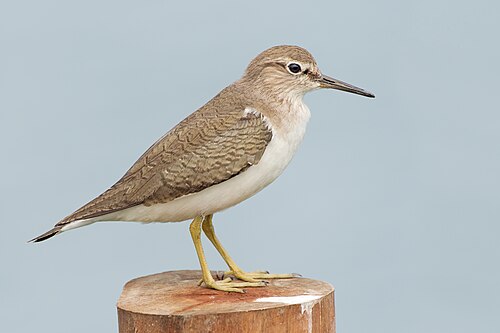
Common Sandpiper
Actitis hypoleucos

Black-naped Tern
Sterna sumatrana

Whiskered Tern
Chlidonias hybrida

Kentish Plover
Charadrius alexandrinus

Whimbrel
Numenius phaeopus

White-winged Tern
Chlidonias leucopterus

Common Tern
Sterna hirundo

Little Tern
Sternula albifrons

Beach Thick-knee
Esacus magnirostris

Barred Buttonquail
Turnix suscitator

Black-bellied Plover
Pluvialis squatarola

Grey-tailed Tattler
Tringa brevipes
Global Distribution
Where this species is recorded worldwide. Restricted to human observations from 2019 onwards — the same kind of record and the same period the probabilities on this page are built from, so collar-tracking studies, camera-trap arrays and museum specimens are excluded. Around Santa Rosa that removes 5,924 GPS fixes from a handful of tagged jaguars.
where this species is recorded (GBIF density — it tracks where observers go, not how likely a sighting is) · parks where it occurs — tap a pin for the sighting probability there
Parks Where Found
| # | Park | Country | Daily sighting probability |
|---|---|---|---|
| 1 | Cape Range | 🇦🇺 Australia | |
| 2 | Ningaloo Marine Park | 🇦🇺 Australia | |
| 3 | Abel Tasman National Park | 🇳🇿 New Zealand | |
| 4 | Fiordland National Park | 🇳🇿 New Zealand | |
| 5 | Litchfield National Park | 🇦🇺 Australia | |
| 6 | Daintree National Park | 🇦🇺 Australia | |
| 7 | Kakadu National Park | 🇦🇺 Australia | |
| 8 | Bali Barat National Park | 🇮🇩 Indonesia | |
| 9 | Grampians National Park | 🇦🇺 Australia | |
| 10 | Tongariro National Park | 🇳🇿 New Zealand | |
| 11 | Great Otway National Park | 🇦🇺 Australia | |
| 12 | Blue Mountains National Park | 🇦🇺 Australia | |
| 13 | Aoraki Mount Cook National Park | 🇳🇿 New Zealand | |
| 14 | Arthur's Pass National Park | 🇳🇿 New Zealand | |
| 15 | Way Kambas National Park | 🇮🇩 Indonesia | |
| 16 | Raja Ampat | 🇮🇩 Indonesia | |
| 17 | Tangkoko Nature Reserve | 🇮🇩 Indonesia | |
| 18 | Rakiura National Park | 🇳🇿 New Zealand | |
| 19 | Royal National Park | 🇦🇺 Australia |