


Black-winged Flycatcher-shrike
Hemipus hirundinaceus
- KingdomAnimalia (Animals)
- PhylumChordata (Chordates)
- ClassAves (Birds)
- OrderPasseriformes (Perching Birds)
- FamilyTephrodornithidae
- GenusHemipus (Flycatcher-shrikes)
- SpeciesHemipus hirundinaceus (Black-winged Flycatcher-shrike)
About the Black-winged Flycatcher-shrike
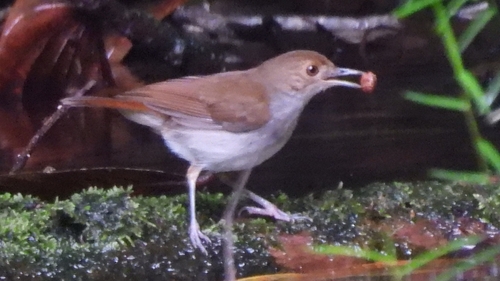
The black-winged flycatcher-shrike (Hemipus hirundinaceus) is a species of bird in the flycatcher-shrike genus, Hemipus. It is usually placed in the Vangidae. It is found in the Malay Peninsula and the Greater Sunda Islands. Its natural habitats are lowland forests and sometimes swamps and mangroves. The International Union for Conservation of Nature (IUCN) has assessed it as being of least concern.
Thomas Horsfield described this species as Muscicapa obscura in 1821, and it was later transferred to the genus Hemipus, as Hemipus obscurus. Because Muscicapa obscura was an unavailable name, the name Muscicapa hirundinacea published by Coenraad Jacob Temminck in 1822 was used, making the name Hemipus hirundinaceus. The IOC World Bird List transferred the genus Hemipus from Campephagidae, the cuckooshrikes, to Tephrodornithidae, the woodshrikes, because it was found to be closely related to Tephrodornis in 2006. The Handbook of the Birds of the World places both genera in Vangidae.
The black-winged flycatcher-shrike is about 15 cm (5.9 in) long. The male's head and upperparts are black, having a green sheen. The rump has black and white bars, and the tail... Wikipedia →
Closest Relatives at Tanjung Puting National Park

Bar-winged Flycatcher-shrike
Hemipus picatus

Rufous-winged Philentoma
Philentoma pyrhoptera

Malaysian Pied-Fantail
Rhipidura javanica

Black-and-red Broadbill
Cymbirhynchus macrorhynchos

Olive-winged Bulbul
Pycnonotus plumosus
White-chested Babbler
Trichastoma rostratum

Little Spiderhunter
Arachnothera longirostra

Slender-billed Crow
Corvus enca

Van Hasselt's Sunbird
Leptocoma brasiliana

Malaysian Blue-Flycatcher
Cyornis turcosus

Greater Racket-tailed Drongo
Dicrurus paradiseus

Green Iora
Aegithina viridissima
Global Distribution
Where this species is recorded worldwide. Restricted to human observations from 2019 onwards — the same kind of record and the same period the probabilities on this page are built from, so collar-tracking studies, camera-trap arrays and museum specimens are excluded. Around Santa Rosa that removes 5,924 GPS fixes from a handful of tagged jaguars.
where this species is recorded (GBIF density — it tracks where observers go, not how likely a sighting is) · parks where it occurs — tap a pin for the sighting probability there
Parks Where Found
| # | Park | Country | Daily sighting probability |
|---|---|---|---|
| 1 | Bako National Park | 🇲🇾 Malaysia | |
| 2 | Bali Barat National Park | 🇮🇩 Indonesia | |
| 3 | Sepilok | 🇲🇾 Malaysia | |
| 4 | Way Kambas National Park | 🇮🇩 Indonesia | |
| 5 | Tanjung Puting National Park | 🇮🇩 Indonesia | |
| 6 | Gunung Leuser National Park | 🇮🇩 Indonesia | |
| 7 | Danum Valley Conservation Area | 🇲🇾 Malaysia | |
| 8 | Kinabatangan Wildlife Sanctuary | 🇲🇾 Malaysia | |
| 9 | Taman Negara National Park | 🇲🇾 Malaysia | |
| 10 | Kinabalu Park | 🇲🇾 Malaysia | |
| 11 | Kerinci Seblat National Park | 🇮🇩 Indonesia |
Quick answers
What are the chances of seeing a Black-winged Flycatcher-shrike in Tanjung Puting National Park?
About 20% of wildlife watchers report a Black-winged Flycatcher-shrike sighting in Tanjung Puting National Park, based on 17 verified sightings from GBIF citizen-science data.
When is the best time to see Black-winged Flycatcher-shrike in Tanjung Puting National Park?
May has the highest sighting rate for Black-winged Flycatcher-shrike in Tanjung Puting National Park in our monthly data.