


Malaysian Blue-Flycatcher
Cyornis turcosus
- KingdomAnimalia (Animals)
- PhylumChordata (Chordates)
- ClassAves (Birds)
- OrderPasseriformes (Perching Birds)
- FamilyMuscicapidae (Old World Flycatchers, Robins, and Chats)
- GenusCyornis (Blue Flycatchers and Jungle Flycatchers)
- SpeciesCyornis turcosus (Malaysian Blue-Flycatcher)
About the Malaysian Blue-Flycatcher
The Malaysian blue flycatcher (Cyornis turcosus) is a species of bird in the family Muscicapidae. It has a brilliant blue upperparts, a pale orange throat and chest, and a white belly. A slightly paler female has a whitish throat, while a male's is blue; the sexes are otherwise quite similar.
The head is fairly uniformly blue, without boldly lighter or darker patches, unlike in many other "blue flycatchers". Pale and restricted orange also serve as a helpful identifying feature. A lowland species, restricted to secluded riverine forests in Sumatra and the Malay Peninsula but found in a variety of dry and wet forests on Borneo.
Its natural habitat is subtropical or tropical moist lowland forests, found in Malaysia, Thailand, Indonesia and Brunei. It is threatened by habitat loss. The bird is well known as 'Burung Sambar Biru' in Malaysia. Wikipedia →
Closest Relatives at Tanjung Puting National Park

Mangrove Blue-Flycatcher
Cyornis rufigastra

Bornean Blue-Flycatcher
Cyornis superbus

Oriental Magpie-Robin
Copsychus saularis

Grey-chested Jungle Flycatcher
Rhinomyias umbratilis

Rufous-chested Flycatcher
Ficedula dumetoria

Siberian Blue Robin
Luscinia cyane

Malaysian Pied-Fantail
Rhipidura javanica

Black-and-red Broadbill
Cymbirhynchus macrorhynchos

Olive-winged Bulbul
Pycnonotus plumosus
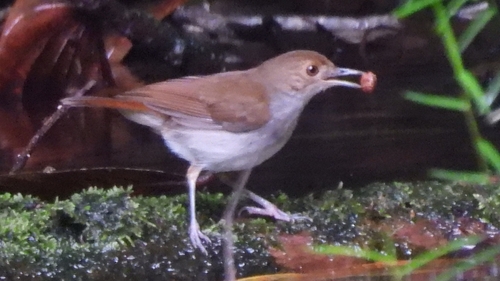
White-chested Babbler
Trichastoma rostratum

Little Spiderhunter
Arachnothera longirostra

Slender-billed Crow
Corvus enca
Global Distribution
Where this species is recorded worldwide. Restricted to human observations from 2019 onwards — the same kind of record and the same period the probabilities on this page are built from, so collar-tracking studies, camera-trap arrays and museum specimens are excluded. Around Santa Rosa that removes 5,924 GPS fixes from a handful of tagged jaguars.
where this species is recorded (GBIF density — it tracks where observers go, not how likely a sighting is) · parks where it occurs — tap a pin for the sighting probability there
Parks Where Found
| # | Park | Country | Daily sighting probability |
|---|---|---|---|
| 1 | Way Kambas National Park | 🇮🇩 Indonesia | |
| 2 | Kinabatangan Wildlife Sanctuary | 🇲🇾 Malaysia | |
| 3 | Tanjung Puting National Park | 🇮🇩 Indonesia | |
| 4 | Danum Valley Conservation Area | 🇲🇾 Malaysia | |
| 5 | Taman Negara National Park | 🇲🇾 Malaysia | |
| 6 | Sepilok | 🇲🇾 Malaysia | |
| 7 | Kinabalu Park | 🇲🇾 Malaysia | |
| 8 | Kerinci Seblat National Park | 🇮🇩 Indonesia | |
| 9 | Bako National Park | 🇲🇾 Malaysia | |
| 10 | Gunung Leuser National Park | 🇮🇩 Indonesia |
Quick answers
What are the chances of seeing a Malaysian Blue-Flycatcher in Tanjung Puting National Park?
About 20% of wildlife watchers report a Malaysian Blue-Flycatcher sighting in Tanjung Puting National Park, based on 22 verified sightings from GBIF citizen-science data.
When is the best time to see Malaysian Blue-Flycatcher in Tanjung Puting National Park?
July has the highest sighting rate for Malaysian Blue-Flycatcher in Tanjung Puting National Park in our monthly data.