


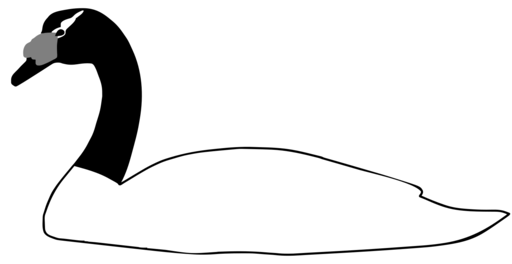
Black-necked Swan
Cygnus melancoryphus
Silhouette: Edwin Price · PhyloPic
- KingdomAnimalia (Animals)
- PhylumChordata (Chordates)
- ClassAves (Birds)
- OrderAnseriformes (Waterfowl)
- FamilyAnatidae (Ducks, Geese, and Swans)
- GenusCygnus (True Swans)
- SpeciesCygnus melancoryphus (Black-necked Swan)
About the Black-necked Swan
The black-necked swan (Cygnus melancoryphus) is a species of waterfowl in the tribe Cygnini of the subfamily Anserinae. It is found in Argentina, Brazil, Chile, Uruguay, and the Falkland Islands. The black-necked swan has occasionally been placed by itself in the genus Sthenelides. Its closest relatives are the black swan (C. atratus) and mute swan (C. olor). It is monotypic.
The black-necked swan is the only member of its genus that breeds in the neotropics and is the largest waterfowl native to South America. Adults are 102 to 124 cm (40 to 49 in) in length. Its wingspan in winter averages 160 cm (5.2 ft), less at 136 cm (4.46 ft) in spring, due to loss of some primary feathers while moulting. Males weigh 4.6 to 8.7 kg (10 to 19 lb) and females 3.5 to 4.4 kg (7.7 to 9.7 lb). The black-necked swan is the lightest true swan on average. The sexes are alike. Adults' body plumage is white and the neck and head black; the latter usually has a white stripe behind the eye. They have a prominent red knob at the base of their bill. Juveniles are grayish rather than white and lack the knob until their third or fourth year. Wikipedia →
Recent sightings of Black-necked Swan in Tierra del Fuego National Park
LIVEiNaturalistClosest Relatives at Tierra del Fuego National Park

 Upland Goose
Chloephaga picta

 Crested Duck
Lophonetta specularioides

 Flightless Steamer-Duck
Tachyeres pteneres

Flying Steamer-Duck
Tachyeres patachonicus

Yellow-billed Pintail
Anas georgica

 Speckled Teal
Anas flavirostris

 Ashy-headed Goose
Chloephaga poliocephala

Spectacled Duck
Speculanas specularis

Kelp Goose
Chloephaga hybrida

 Chiloé Wigeon
Mareca sibilatrix

Ruddy-headed Goose
Chloephaga rubidiceps

Red Shoveler
Spatula platalea
Global Distribution
Warmer areas are where this animal is recorded most often.
Parks Where Found
| # | Park | Country | Daily sighting probability |
|---|---|---|---|
| 1 | Torres del Paine National Park | 🇨🇱 Chile | |
| 2 | Tierra del Fuego National Park | 🇦🇷 Argentina | |
| 3 | Península Valdés | 🇦🇷 Argentina | |
| 4 | Nahuel Huapi National Park | 🇦🇷 Argentina | |
| 5 | Wadden Sea National Park | 🇩🇪 Germany | |
| 6 | El Palmar National Park | 🇦🇷 Argentina | |
| 7 | Vicente Pérez Rosales National Park | 🇨🇱 Chile |
Quick answers
What are the chances of seeing a Black-necked Swan in Tierra del Fuego National Park?
About 10% of wildlife watchers report a Black-necked Swan sighting in Tierra del Fuego National Park, based on 205 verified sightings from GBIF citizen-science data.
When is the best time to see Black-necked Swan in Tierra del Fuego National Park?
July has the highest sighting rate for Black-necked Swan in Tierra del Fuego National Park in our monthly data.