

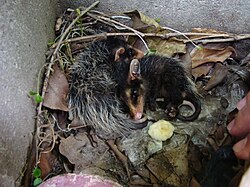



Big-eared Opossum
Didelphis aurita
Silhouette: Sarah Werning · PhyloPic
- KingdomAnimalia (Animals)
- PhylumChordata (Chordates)
- ClassMammalia (Mammals)
- OrderDidelphimorphia (Opossums)
- FamilyDidelphidae (Opossums)
- GenusDidelphis (Large American Opossums)
- SpeciesDidelphis aurita (Big-eared Opossum)
About the Big-eared Opossum
The big-eared opossum (Didelphis aurita), also known as a saruê, or the gambá, is an opossum species from South America. It is found in Argentina, Brazil and Paraguay. This species, which was considered a population of the common opossum (D. marsupialis) for some time, was originally described as D. azarae by Coenraad Jacob Temminck in 1824, but this name was incorrectly given to the white-eared opossum (D. albiventris) for over 160 years. As such, the name azarae has been abandoned.
Due to carrying offspring, female big-eared opossums tend to stay in smaller areas and reduce their movements. facts and pictures at Animal Diversity Web Diogo Loretto, & Marcus Vinícius Vieira. (2005). The Effects of Reproductive and Climatic Seasons on Movements in the Black-Eared Opossum (Didelphis aurita Wied-Neuwied, 1826). Journal of Mammalogy, 86(2), 287–293. http://www.jstor.org/stable/4094347 Wikipedia →
Recent sightings of Big-eared Opossum in Tijuca National Park
LIVEiNaturalistClosest Relatives at Tijuca National Park


Global Distribution
Warmer areas are where this animal is recorded most often.
Parks Where Found
| # | Park | Country | Daily sighting probability |
|---|---|---|---|
| 1 | Serra dos Órgãos National Park | 🇧🇷 Brazil | |
| 2 | Tijuca National Park | 🇧🇷 Brazil | |
| 3 | Iguaçu National Park | 🇧🇷 Brazil | |
| 4 | Iguazú National Park | 🇦🇷 Argentina | |
| 5 | Chapada Diamantina National Park | 🇧🇷 Brazil |
Quick answers
What are the chances of seeing a Big-eared Opossum in Tijuca National Park?
About 20% of wildlife watchers report a Big-eared Opossum sighting in Tijuca National Park, based on 30 verified sightings from GBIF citizen-science data.
When is the best time to see Big-eared Opossum in Tijuca National Park?
November has the highest sighting rate for Big-eared Opossum in Tijuca National Park in our monthly data.