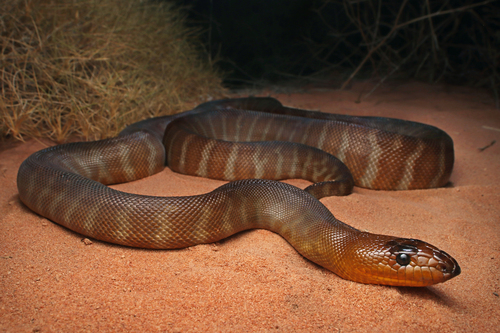

Ramsay's Python
Aspidites ramsayi
Silhouette: SeismicShrimp · PhyloPic
- KingdomAnimalia (Animals)
- PhylumChordata (Chordates)
- ClassSquamata
- FamilyPythonidae (Pythons)
- GenusAspidites (Shield-bearing Pythons)
- SpeciesAspidites ramsayi (Ramsay's Python)
About the Ramsay's Python
The woma python (Aspidites ramsayi), also known commonly as Ramsay's python, the sand python, and simply the woma, is a species of snake in the family Pythonidae, endemic to Australia. Once common throughout Western Australia, it has become critically endangered in some regions.
William John Macleay originally described the species in 1882 as Aspidiotes ramsayi. The specific name, ramsayi, is in honor of Australian zoologist Edward Pierson Ramsay. This is one of two species of Aspidites, the pitless pythons, an Australian genus of the family Pythonidae. The generic name, Aspidites, translates to "shield bearer" in reference to the symmetrically shaped head scales.
Adults of A. ramsayi typically are around 1.5 m (4.5 feet) in total length (including tail). The head is narrow, and the eyes are small. The body is broad and flattish in profile, while the tail tapers to a thin point. The dorsal scales are small and smooth, with 50–65 rows at midbody. The ventral scales are 280–315 in number, with an undivided anal plate, and 40–45 mostly single subcaudal scales. Some of the posterior subcaudals may be irregularly divided.
The dorsal color may be pale brown... Wikipedia →
Recent sightings of Ramsay's Python in Uluru-Kata Tjuta National Park
LIVEiNaturalistClosest Relatives at Uluru-Kata Tjuta National Park


Global Distribution
Warmer areas are where this animal is recorded most often.
Parks Where Found
| # | Park | Country | Daily sighting probability |
|---|---|---|---|
| 1 | Uluru-Kata Tjuta National Park | 🇦🇺 Australia |
More parks will be added in future updates.