

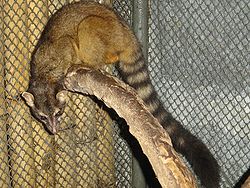



Cacomistle
Bassariscus sumichrasti
Silhouette: Gabriela Palomo-Munoz · PhyloPic
- KingdomAnimalia (Animals)
- PhylumChordata (Chordates)
- ClassMammalia (Mammals)
- OrderCarnivora (Carnivorans)
- FamilyProcyonidae (Raccoons, Coatis, and Allies)
- GenusBassariscus (Cacomistles)
- SpeciesBassariscus sumichrasti (Cacomistle)
About the Cacomistle
The cacomistle (Bassariscus sumichrasti), also spelled cacomixtle, is a primarily nocturnal, arboreal, omnivorous member of the carnivoran family Procyonidae (coatis, kinkajous and raccoons). Depending on the location, its preferred habitats are humid and tropical evergreen jungle and montane cloud forests; seasonally, it may venture into drier, deciduous forests.
Although its total population is listed as being of "least concern" (i.e., stable), the cacomistle is still a highly cryptic, secretive animal, and generally an uncommon sight throughout much of its range (from southern México to western Panamá); this fact is especially true in Costa Rica, where it inhabits only a very small area. Additionally, the species is completely dependent on trees and dense vegetation for habitat, making it particularly susceptible to deforestation.
The name cacomistle comes from the Nahuatl language (tlahcomiztli) and means "half-cat" or "half-puma"; the same name is also given, by some, to the North American Bassariscus astutus, more commonly known as the ringtail (or, semi-inaccurately, ringtail 'cat'). This "sister species" of the cacomistle inhabits a much more northerly and less tropical range, from arid Northern Mexico into the Southwestern United States. Wikipedia →
Recent sightings of Cacomistle in Volcán Barú National Park
LIVEiNaturalistClosest Relatives at Volcán Barú National Park


Global Distribution
Warmer areas are where this animal is recorded most often.
Parks Where Found
| # | Park | Country | Daily sighting probability |
|---|---|---|---|
| 1 | Volcán Barú National Park | 🇵🇦 Panama | |
| 2 | Los Quetzales National Park | 🇨🇷 Costa Rica | |
| 3 | La Amistad International Park (Panama) | 🇵🇦 Panama | |
| 4 | Tapantí-Macizo de la Muerte National Park | 🇨🇷 Costa Rica | |
| 5 | La Tigra National Park | 🇭🇳 Honduras | |
| 6 | Celaque National Park | 🇭🇳 Honduras | |
| 7 | Braulio Carrillo National Park | 🇨🇷 Costa Rica | |
| 8 | Calakmul Biosphere Reserve | 🇲🇽 Mexico | |
| 9 | Montes Azules Biosphere Reserve | 🇲🇽 Mexico |
Quick answers
What are the chances of seeing a Cacomistle in Volcán Barú National Park?
About 20% of wildlife watchers report a Cacomistle sighting in Volcán Barú National Park, based on 8 verified sightings from GBIF citizen-science data.
When is the best time to see Cacomistle in Volcán Barú National Park?
November has the highest sighting rate for Cacomistle in Volcán Barú National Park in our monthly data.