
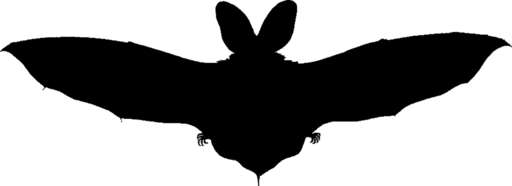
Brown Big-eared Bat
Plecotus auritus
Silhouette: Ernst Haeckel · PhyloPic
- KingdomAnimalia (Animals)
- PhylumChordata (Chordates)
- ClassMammalia (Mammals)
- OrderChiroptera (Bats)
- FamilyVespertilionidae (Evening Bats)
- GenusPlecotus (Long-eared Bats)
- SpeciesPlecotus auritus (Brown Big-eared Bat)
About the Brown Big-eared Bat
The brown long-eared bat or common long-eared bat (Plecotus auritus) is a small Eurasian insectivorous bat. It has distinctive ears, long and with a distinctive fold. It is extremely similar to the much rarer grey long-eared bat, which was only validated as a distinct species in the 1960s. An adult brown long-eared bat has a body length of 4.5–4.8 cm, a tail of 4.1–4.6 cm, and a forearm length of 4–4.2 cm. The ears are 3.3–3.9 cm in length, and readily distinguish the long-eared bats from most other bat species. They are relatively slow flyers compared to other bat species.
The brown long-eared bat is found throughout Europe, with the exception of Greece, southern Italy and southern Spain. It is found to the east up to the Urals and Caucasus. The UK distribution can be found on the National Biodiversity Network website.
Brown long-eared bats regularly utilise buildings roosting in undisturbed roof spaces either singly, in crevices and timber, or in clusters around chimneys and ridge ends. This species also roosts in treeholes, bat boxes and caves, which are important as winter hibernation sites. The roosts in trees may be close to the ground. Emergence from roost sites... Wikipedia →
Recent sightings of Brown Big-eared Bat in Wadden Sea National Park
LIVEiNaturalistClosest Relatives at Wadden Sea National Park

 Daubenton's bat
Myotis daubentonii

 Common Pipistrelle
Pipistrellus pipistrellus

 Nathusius's pipistrelle
Pipistrellus nathusii

 Pygmy Pipistrelle
Pipistrellus pygmaeus

 Whiskered Bat
Myotis mystacinus

 Natterer's Bat
Myotis nattereri

 Noctule
Nyctalus noctula

pond bat
Myotis dasycneme

 Mouse-eared Bat
Myotis myotis
Global Distribution
Warmer areas are where this animal is recorded most often.
Parks Where Found
| # | Park | Country | Daily sighting probability |
|---|---|---|---|
| 1 | Wadden Sea National Park | 🇩🇪 Germany | |
| 2 | Gauja National Park | 🇱🇻 Latvia | |
| 3 | Snowdonia National Park | 🇬🇧 United Kingdom | |
| 4 | Białowieża National Park | 🇵🇱 Poland | |
| 5 | Aigüestortes National Park | 🇪🇸 Spain | |
| 6 | Mercantour National Park | 🇫🇷 France | |
| 7 | Triglav National Park | 🇸🇮 Slovenia | |
| 8 | Bavarian Forest National Park | 🇩🇪 Germany | |
| 9 | Pyrénées National Park | 🇫🇷 France |
Quick answers
What are the chances of seeing a Brown Big-eared Bat in Wadden Sea National Park?
Under 5% of wildlife watchers report a Brown Big-eared Bat sighting in Wadden Sea National Park, based on 10 verified sightings from GBIF citizen-science data.
When is the best time to see Brown Big-eared Bat in Wadden Sea National Park?
January has the highest sighting rate for Brown Big-eared Bat in Wadden Sea National Park in our monthly data.