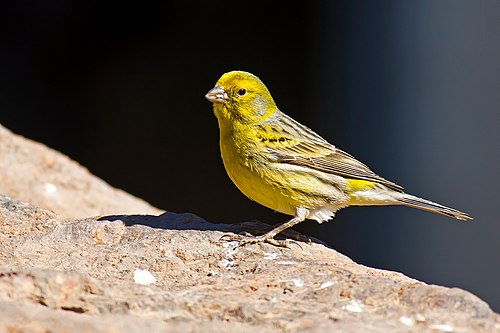

Island Canary
Serinus canaria
Silhouette: Sheatherius · PhyloPic
- KingdomAnimalia (Animals)
- PhylumChordata (Chordates)
- ClassAves (Birds)
- OrderPasseriformes (Perching Birds)
- FamilyFringillidae (Finches, Euphonias, and Allies)
- GenusSerinus (Typical Serins and Allies)
- SpeciesSerinus canaria (Island Canary)
About the Island Canary
The Atlantic canary (Serinus canaria), known worldwide simply as the wild canary and also called the island canary, common canary, or canary, is a small passerine bird belonging to the genus Serinus in the true finch family, Fringillidae. It is native to the Canary Islands, the Azores, and Madeira. Wild birds are mostly yellow-green, with brownish streaking on the back. The species is common in captivity and a number of colour varieties have been bred.
This bird is the natural symbol of the Canary Islands, together with the Canary Island date palm. The Atlantic canary was formally described in 1758 by the Swedish naturalist Carl Linnaeus in the tenth edition of his Systema Naturae. He placed it with the finches in the genus Fringilla and coined the binomial name Fringilla canaria. In 1555 the Swiss naturalist Conrad Gessner had used the Latin name Canaria for the species in his book Historia animalium. The Atlantic canary is now one of eight species placed in the genus Serinus that was introduced in 1816 by the German naturalist Carl Ludwig Koch. The species is considered to be monotypic, with no subspecies being recognised; domesticated canaries are sometimes cited as... Wikipedia →
Recent sightings of Island Canary in Wadden Sea National Park
LIVEiNaturalistClosest Relatives at Wadden Sea National Park

 European Serin
Serinus serinus

 Chaffinch
Fringilla coelebs

 Eurasian Goldfinch
Carduelis carduelis

 Linnet
Linaria cannabina

 European Greenfinch
Chloris chloris

Eurasian Siskin
Spinus spinus

 Eurasian Bullfinch
Pyrrhula pyrrhula

Brambling
Fringilla montifringilla

Hawfinch
Coccothraustes coccothraustes

Common Redpoll
Acanthis flammea

 Twite
Linaria flavirostris

 Red Crossbill
Loxia curvirostra
Global Distribution
Warmer areas are where this animal is recorded most often.
Parks Where Found
| # | Park | Country | Daily sighting probability |
|---|---|---|---|
| 1 | Namib-Naukluft National Park | 🇳🇦 Namibia | |
| 2 | Wadden Sea National Park | 🇩🇪 Germany | |
| 3 | Monfragüe National Park | 🇪🇸 Spain |