


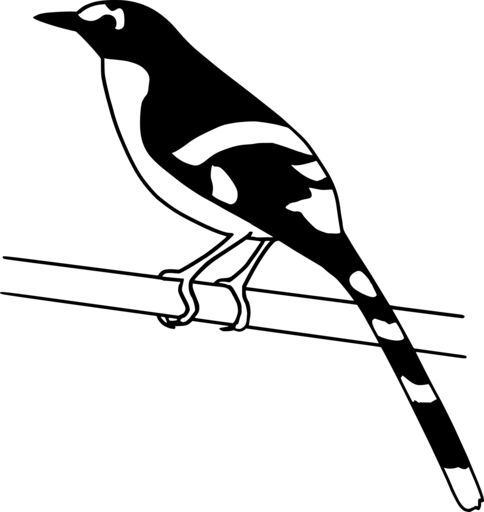
White-crowned Forktail
Enicurus leschenaulti
Silhouette: Andy Wilson · PhyloPic
- KingdomAnimalia (Animals)
- PhylumChordata (Chordates)
- ClassAves (Birds)
- OrderPasseriformes (Perching Birds)
- FamilyMuscicapidae (Old World Flycatchers, Robins, and Chats)
- GenusEnicurus (Forktails)
- SpeciesEnicurus leschenaulti (White-crowned Forktail)
About the White-crowned Forktail
The white-crowned forktail (Enicurus leschenaulti) is a species of forktail in the family Muscicapidae. Formally described in 1818, it has five subspecies, each occupying a different geographic range. The largest of the forktails, Enicurus leschenaulti, is between 25 and 28 centimetres (9.8 and 11.0 in) long. It has a black throat and breast, black mantle, and largely black wings. The rump and lower back are white, and the bird has a prominent white crown, from which it gets its name. As with other forktails, the tail is long, deeply forked, and banded in black and white. A variety of whistling and clicking calls have been described. Slight morphological differences have been observed between subspecies.
A shy bird, the white-crowned forktail stays near water, and forages on the edges of rivers and streams for invertebrates. Its breeding season is between March and September, and possibly extends till October. Its nests are also built near the water, and are constructed of plant material. The eggs are between two and five in number, though there is latitudinal variation. Multiple broods in a year have been observed in China. The white-crowned forktail is found in China, Southeast Asia and also in northeastern parts of the Indian subcontinent. Its natural habitats are subtropical or tropical moist lowland forests and subtropical or tropical moist montane forests. Its elevational range varies across its range, from a minimum of 185 metres (607 ft) above sea level to a maximum of 2,400 metres (7,900 ft). It is categorized as a species of least concern by the International Union for Conservation of Nature. Wikipedia →
Recent sightings of White-crowned Forktail in Way Kambas National Park
LIVEiNaturalistClosest Relatives at Way Kambas National Park

 Malaysian Blue-Flycatcher
Cyornis turcosus

 Grey-chested Jungle Flycatcher
Rhinomyias umbratilis

 Korean Flycatcher
Ficedula zanthopygia

Mangrove Blue-Flycatcher
Cyornis rufigastra

 Siberian Blue Robin
Luscinia cyane

 Asian Brown Flycatcher
Muscicapa latirostris

Fulvous-chested Jungle Flycatcher
Rhinomyias olivaceus

Dark-sided Flycatcher
Muscicapa sibirica

 Greater Racket-tailed Drongo
Dicrurus paradiseus

 Yellow-vented Bulbul
Pycnonotus goiavier

 Ashy Tailorbird
Orthotomus ruficeps

 Malayan Banded-Pitta
Hydrornis irena
Global Distribution
Warmer areas are where this animal is recorded most often.
Parks Where Found
| # | Park | Country | Daily sighting probability |
|---|---|---|---|
| 1 | Danum Valley Conservation Area | 🇲🇾 Malaysia | |
| 2 | Namdapha National Park | 🇮🇳 India | |
| 3 | Doi Inthanon National Park | 🇹🇭 Thailand | |
| 4 | Taman Negara National Park | 🇲🇾 Malaysia | |
| 5 | Khao Luang National Park | 🇹🇭 Thailand | |
| 6 | Khao Yai National Park | 🇹🇭 Thailand | |
| 7 | Kerinci Seblat National Park | 🇮🇩 Indonesia | |
| 8 | Sepilok | 🇲🇾 Malaysia | |
| 9 | Kinabalu Park | 🇲🇾 Malaysia | |
| 10 | Jiuzhaigou National Park | 🇨🇳 China | |
| 11 | Way Kambas National Park | 🇮🇩 Indonesia | |
| 12 | Khao Sok National Park | 🇹🇭 Thailand | |
| 13 | Bali Barat National Park | 🇮🇩 Indonesia | |
| 14 | Kinabatangan Wildlife Sanctuary | 🇲🇾 Malaysia |