
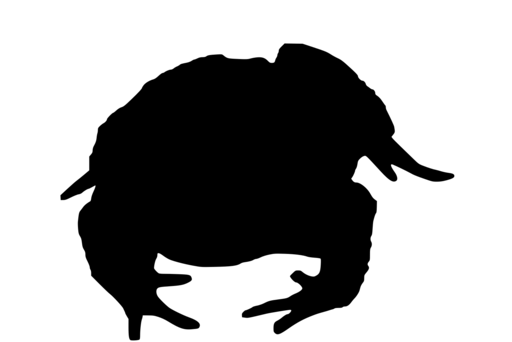
Canadian Toad
Anaxyrus hemiophrys
Silhouette: Michael Scroggie, from original photograph by Gary M. Stolz, USFWS (original photograph in public domain). · PhyloPic
- KingdomAnimalia (Animals)
- PhylumChordata (Chordates)
- ClassAmphibia (Amphibians)
- OrderAnura (Frogs and Toads)
- FamilyBufonidae (True Toads)
- GenusAnaxyrus (North American Toads)
- SpeciesAnaxyrus hemiophrys (Canadian Toad)
About the Canadian Toad
The Canadian toad (Anaxyrus hemiophrys), also known commonly as the Dakota toad, is a species of toad that ranges from the prairie regions of western Canada south to parts of the upper midwest of the United States. It belongs to the family Bufonidae, the "true" toads. Its specific name is derived from the Latin word hemiophrys, meaning eyebrow, which refers to its pronounced cranial crest between and behind the eyes. Anaxyrus hemiophrys displays the typical toad characteristics: it lacks a tail and teeth, it has a horizontal pupil, and its dry skin is thick and warty.
The Canadian toad can grow to around 7.6 cm (3 in) in length. Fully grown adult males are usually 5.6 to 6.9 cm (2.2–2.7 in), while females are a little bigger between the ranges of 5.6 and 7.9 cm (2.2–3.1 in) and they weigh between 35 and 55 g. Their colouring is described by Cope (1886) as "brown, marked on the back with a median yellowish line, and two to three rows of brown spots of medium size on each side of it." Each spot has one to two tubercles in their centers which are redder in colour than the rest of the spots. He also identified two spots on the upper lip, one below the tympanum and a large... Wikipedia →
Recent sightings of Canadian Toad in Wood Buffalo National Park
LIVEiNaturalistClosest Relatives at Wood Buffalo National Park


Global Distribution
Warmer areas are where this animal is recorded most often.
Parks Where Found
| # | Park | Country | Daily sighting probability |
|---|---|---|---|
| 1 | Wood Buffalo National Park | 🇨🇦 Canada | |
| 2 | Riding Mountain National Park | 🇨🇦 Canada |