


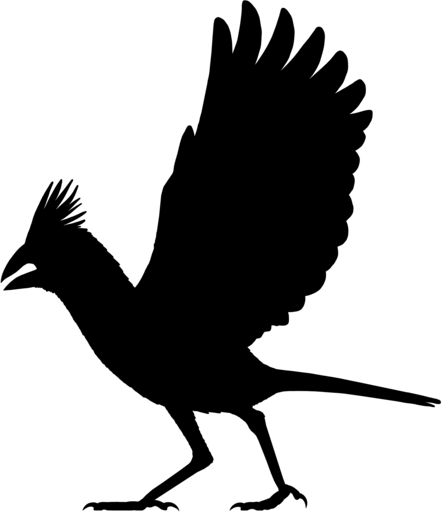
Northern Cardinal
Cardinalis cardinalis
Silhouette: Scott Hartman · PhyloPic
- KingdomAnimalia (Animals)
- PhylumChordata (Chordates)
- ClassAves (Birds)
- OrderPasseriformes (Perching Birds)
- FamilyCardinalidae (Cardinals and Allies)
- GenusCardinalis (Typical Cardinals)
- SpeciesCardinalis cardinalis (Northern Cardinal)
About the Northern Cardinal
The northern cardinal (Cardinalis cardinalis), also commonly known as the common cardinal, red cardinal, or simply cardinal, is a bird in the genus Cardinalis. It can be found in southeastern Canada, through the eastern United States from Maine to Minnesota to Texas, New Mexico, southern Arizona, southern California and south through Mexico, Belize, and Guatemala. It is also an introduced species in a few locations such as Bermuda and all major islands of Hawaii since its introduction in 1929. Its habitat includes woodlands, gardens, shrublands, and wetlands. It is the state bird of Illinois, Indiana, Kentucky, North Carolina, Ohio, Virginia, and West Virginia.
The northern cardinal is a mid-sized perching songbird with a body length of 21–23 cm (8.3–9.1 in) and a crest on the top of its head. The species expresses sexual dimorphism: Females are a reddish olive color, and have a gray mask around the beak, while males are a vibrant red color, and have a black mask on the face, as well as a larger crest. Juvenile cardinals do not have the distinctive red-orange beak seen in adult birds until they are almost fully mature. On hatching, their beaks are grayish-black and they do not become the typical orange-red color until they acquire their final adult plumage in the fall.
The northern cardinal is mainly granivorous but also feeds on insects and fruit. The male behaves territorially, marking out his territory with song. During courtship, the male feeds seed to the female beak-to-beak. The northern cardinal's clutch typically contains three to four eggs, with two to four clutches produced each year. It was once prized as a pet, but its sale was banned in the United States by the Migratory Bird Treaty Act of 1918. Wikipedia →
Recent sightings of Northern Cardinal in Acadia National Park
LIVEiNaturalistClosest Relatives at Acadia National Park

 Black-headed Grosbeak
Pheucticus melanocephalus

Scarlet Tanager
Piranga olivacea

Rose-breasted Grosbeak
Pheucticus ludovicianus

Western Tanager
Piranga ludoviciana

 Indigo Bunting
Passerina cyanea

Summer Tanager
Piranga rubra

Dickcissel
Spiza americana

Blue Grosbeak
Passerina caerulea

Painted Bunting
Passerina ciris

 American Crow
Corvus brachyrhynchos

 Black-capped Chickadee
Poecile atricapillus

 Song Sparrow
Melospiza melodia
Global Distribution
Warmer areas are where this animal is recorded most often.
Parks Where Found
| # | Park | Country | Daily sighting probability |
|---|---|---|---|
| 1 | Congaree National Park | 🇺🇸 United States | |
| 2 | Point Pelee National Park | 🇨🇦 Canada | |
| 3 | Shenandoah National Park | 🇺🇸 United States | |
| 4 | Cabo Pulmo National Park | 🇲🇽 Mexico | |
| 5 | Everglades National Park | 🇺🇸 United States | |
| 6 | Big Cypress National Preserve | 🇺🇸 United States | |
| 7 | Saguaro National Park | 🇺🇸 United States | |
| 8 | Bahía de Loreto National Park | 🇲🇽 Mexico | |
| 9 | Acadia National Park | 🇺🇸 United States | |
| 10 | Celestún Biosphere Reserve | 🇲🇽 Mexico | |
| 11 | Ría Lagartos Biosphere Reserve | 🇲🇽 Mexico | |
| 12 | Sian Ka'an Biosphere Reserve | 🇲🇽 Mexico | |
| 13 | Calakmul Biosphere Reserve | 🇲🇽 Mexico | |
| 14 | Arrecifes de Cozumel National Park | 🇲🇽 Mexico | |
| 15 | El Vizcaíno Biosphere Reserve | 🇲🇽 Mexico | |
| 16 | Bavarian Forest National Park | 🇩🇪 Germany | |
| 17 | Biotopo Cerro Cahuí | 🇬🇹 Guatemala | |
| 18 | Isle Royale National Park | 🇺🇸 United States | |
| 19 | Tikal National Park | 🇬🇹 Guatemala | |
| 20 | Cape Breton Highlands National Park | 🇨🇦 Canada | |
| 21 | Gros Morne National Park | 🇨🇦 Canada |
Quick answers
What are the chances of seeing a Northern Cardinal in Acadia National Park?
About 30% of wildlife watchers report a Northern Cardinal sighting in Acadia National Park, based on 3,985 verified sightings from GBIF citizen-science data.
When is the best time to see Northern Cardinal in Acadia National Park?
April has the highest sighting rate for Northern Cardinal in Acadia National Park in our monthly data.