
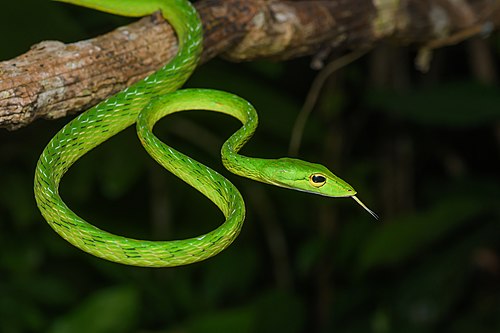
Banded Flying Snake
Chrysopelea pelias
- KingdomAnimalia (Animals)
- PhylumChordata (Chordates)
- ClassSquamata
- FamilyColubridae (Colubrid Snakes)
- GenusChrysopelea (Flying Snakes)
- SpeciesChrysopelea pelias (Banded Flying Snake)
About the Banded Flying Snake
The twin-barred tree snake (Chrysopelea pelias) is a species of colubrid snake found in Southeast Asia. It is also called the banded flying snake. It can glide, as with all species of its genus Chrysopelea, by stretching the body into a flattened strip using its ribs. It is fully arboreal, mostly found in moist forests, and can cover a horizontal distance of about 100 metres in a glide from the top of a tree. It is an oviparous snake.
Chrysopelea pelias belongs to the genus Chrysopelea, which contains four other described species. Chrysopelea is one of five genera belonging to the vine snake subfamily Ahaetuliinae, of which Chrysopelea is most closely related to Dendrelaphis, as shown in the cladogram below:
It is found in Indonesia, Malaysia, Brunei, Singapore, Thailand, and Myanmar. It was erroneously reported in India. Chrysopelea pelias has an overlapping range with the paradise tree snake (Chrysopelea paradisi) in Malaysia, Singapore, Borneo and Indonesia. However, Chrysopelea pelias is not nearly as common as the paradise tree snake.
Chrysopelea pelias begins gliding by jumping in an upward position that seems to be different from... Wikipedia →
Closest Relatives at Bako National Park

Paradise Flying Snake
Chrysopelea paradisi

Oriental Whipsnake
Ahaetulla prasina

Common Bronze-back
Dendrelaphis pictus

Gray Bronzeback
Dendrelaphis caudolineatus

Brown Whip Snake
Dryophiops rubescens

Triangle Keelback
Xenochrophis trianguligerus

Elegant Bronzeback
Dendrelaphis formosus

Spotted Keelback
Xenochrophis maculatus

White-spotted Cat Snake
Boiga drapiezii

Dog-toothed Cat Snake
Boiga cynodon

Black-headed Collared Snake
Sibynophis melanocephalus
Malayan Green Whipsnake
Ahaetulla mycterizans
Global Distribution
Where this species is recorded worldwide. Restricted to human observations from 2019 onwards — the same kind of record and the same period the probabilities on this page are built from, so collar-tracking studies, camera-trap arrays and museum specimens are excluded. Around Santa Rosa that removes 5,924 GPS fixes from a handful of tagged jaguars.
where this species is recorded (GBIF density — it tracks where observers go, not how likely a sighting is) · parks where it occurs — tap a pin for the sighting probability there
Parks Where Found
| # | Park | Country | Daily sighting probability |
|---|---|---|---|
| 1 | Bako National Park | 🇲🇾 Malaysia | |
| 2 | Danum Valley Conservation Area | 🇲🇾 Malaysia | |
| 3 | Gunung Leuser National Park | 🇮🇩 Indonesia | |
| 4 | Kinabalu Park | 🇲🇾 Malaysia | |
| 5 | Khao Luang National Park | 🇹🇭 Thailand | |
| 6 | Taman Negara National Park | 🇲🇾 Malaysia | |
| 7 | Kaeng Krachan National Park | 🇹🇭 Thailand |
Quick answers
What are the chances of seeing a Banded Flying Snake in Bako National Park?
About 20% of wildlife watchers report a Banded Flying Snake sighting in Bako National Park, based on 5 verified sightings from GBIF citizen-science data.
When is the best time to see Banded Flying Snake in Bako National Park?
February has the highest sighting rate for Banded Flying Snake in Bako National Park in our monthly data.