
Crab-eating Frog
Fejervarya cancrivora
- KingdomAnimalia (Animals)
- PhylumChordata (Chordates)
- ClassAmphibia (Amphibians)
- OrderAnura (Frogs and Toads)
- FamilyDicroglossidae (Fork-tongued Frogs)
- GenusFejervarya
- SpeciesFejervarya cancrivora (Crab-eating Frog)
About the Crab-eating Frog
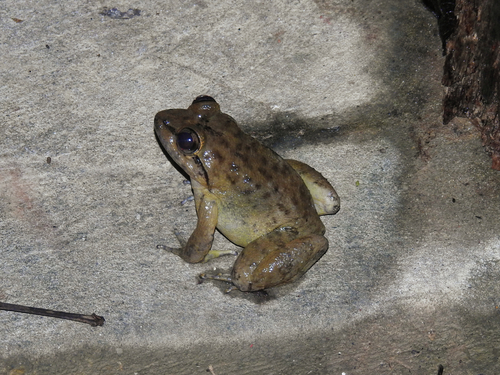
The crab-eating frog (Fejervarya cancrivora) is a frog native to south-eastern Asia including Taiwan, China, Sumatra in Indonesia, the Philippines and more rarely as far west as Orissa in India. It has also been introduced to Guam, most likely from Taiwan. It inhabits mangrove swamps and marshes and is one of 144 known modern amphibians which can tolerate brief excursions into seawater, and is possibly the only extant marine amphibian.
This frog can tolerate marine environments (immersion in sea water for brief periods or brackish water for extended periods) by increasing urea production and retention, and by remaining slightly hyperosmotic within urea and sodium flux. Adults can survive in salt water with salinity as high as 2.8%, and tadpoles can survive salinities as high as 3.9%.
The food sources of the crab-eating frog are mainly determined by the locally available prey. Near fresh water, its diet consists largely of insects. But in an environment with brackish water, small crustaceans, including crabs, form the main part.
In Southeast Asia, the crab-eating frog is locally hunted for food and is often farmed for its edible legs, including in... Wikipedia →
Closest Relatives at Bako National Park

Lesser Swamp Frog
Limnonectes paramacrodon

Sumatran Puddle Frog
Occidozyga sumatrana
Matang Creek Frog
Limnonectes conspicillatus

Brown Marsh Frog
Pulchrana baramica

Copper-cheeked Frog
Chalcorana raniceps

Lowland Dwarf Toad
Pelophryne signata

Common Tree Frog
Polypedates leucomystax

Collett's Tree Frog
Polypedates colletti

four-ridged toad
Ingerophrynus quadriporcatus
_Figure_3_(cropped).jpg)
Bornean Sticky Frog
Kalophrynus meizon

Green Paddy Frog
Hylarana erythraea

Brown-Striped Tree Frog
Polypedates macrotis
Global Distribution
Where this species is recorded worldwide. Restricted to human observations from 2019 onwards — the same kind of record and the same period the probabilities on this page are built from, so collar-tracking studies, camera-trap arrays and museum specimens are excluded. Around Santa Rosa that removes 5,924 GPS fixes from a handful of tagged jaguars.
where this species is recorded (GBIF density — it tracks where observers go, not how likely a sighting is) · parks where it occurs — tap a pin for the sighting probability there
Parks Where Found
| # | Park | Country | Daily sighting probability |
|---|---|---|---|
| 1 | Bako National Park | 🇲🇾 Malaysia | |
| 2 | Kinabatangan Wildlife Sanctuary | 🇲🇾 Malaysia | |
| 3 | Way Kambas National Park | 🇮🇩 Indonesia | |
| 4 | Bali Barat National Park | 🇮🇩 Indonesia | |
| 5 | Kerinci Seblat National Park | 🇮🇩 Indonesia | |
| 6 | Tanjung Puting National Park | 🇮🇩 Indonesia | |
| 7 | Tangkoko Nature Reserve | 🇮🇩 Indonesia | |
| 8 | Raja Ampat | 🇮🇩 Indonesia | |
| 9 | Kaeng Krachan National Park | 🇹🇭 Thailand |
Quick answers
What are the chances of seeing a Crab-eating Frog in Bako National Park?
About 30% of wildlife watchers report a Crab-eating Frog sighting in Bako National Park, based on 8 verified sightings from GBIF citizen-science data.
When is the best time to see Crab-eating Frog in Bako National Park?
January has the highest sighting rate for Crab-eating Frog in Bako National Park in our monthly data.